
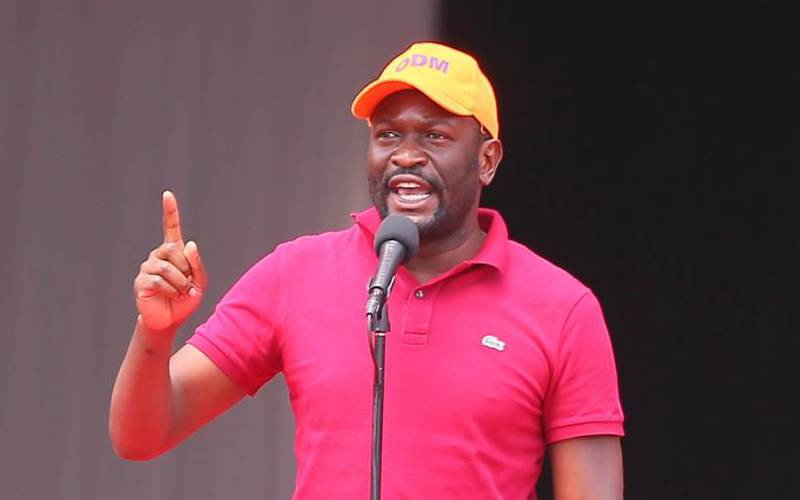
Let us stop pretending.
Some of the loudest attacks on Sifuna are not really about Sifuna.
They are about who is allowed to rise in Kenya—and how high they are allowed to rise.
Sifuna has committed what may be one of the most dangerous offences in Kenyan politics: he has become too visible, too influential and too nationally relevant for the comfort of some people who grew up alongside him.
He is their agemate. Their generation. Someone they once considered simply “one of us”.
Then one day, one of them starts commanding national attention.
That is when admiration can turn into resentment.
There is a strange Kenyan habit of celebrating our peers until they begin to outgrow the peer group. We cheer when one of us succeeds. But when that success starts looking like power, influence or national leadership, the cheering sometimes stops.
Suddenly, the same person becomes “too ambitious”, “too loud”, “not experienced enough” or “who does he think he is?”
And age becomes a weapon.
Sifuna has also stepped into a political space that has historically produced some of the most consequential figures in Kenyan politics: the journey from being a voice of a community to becoming a national political character.
That path was once walked by Raila Odinga.
Sifuna is not Raila. He does not need to be. But his emergence as a national voice inevitably triggers comparisons—and, for some, anxiety.
Because when someone from your own generation begins to acquire a national following, people are forced to confront an uncomfortable question:
Why not me?
Then comes the ethnic layer, which Kenya knows too well.
We still have people who believe leadership should come with an ethnic address. You can speak nationally, but only within certain limits. You can aspire, but don't appear to aspire too much. You can represent your community, but don't dare become bigger than the community.
That is not political criticism.
That is political gatekeeping.
Of course, Sifuna must be criticised.
He is a politician. His record should be examined. His statements should be challenged. His decisions should be questioned. If his politics fail, he should be held accountable.
But let us distinguish accountability from hostility.
Not every attack is principled. Not every insult is political analysis. Not every disagreement is ideological.
Sometimes jealousy puts on a suit and calls itself political commentary.
Sometimes ethnic prejudice learns sophisticated vocabulary.
And sometimes people simply cannot stand watching someone they consider their equal rise beyond the level at which they had mentally placed them.
That may be the real Sifuna problem.
Not that he is perfect.
Not that he is destined for the presidency.
Not even that everyone agrees with his politics.
The problem, for some, may simply be that he has dared to become bigger than the box they put him in.
And Kenya has done this before.
We have a habit of cutting down our own trees the moment they begin to rise above the forest.
Perhaps it is time to stop.
Let Sifuna rise.
Let him stumble.
Let him succeed.
Let him fail.
Let him be challenged.
Let him be defeated if he deserves defeat.
But let the judgement be based on what he does—not where he comes from, how old he is, or how uncomfortable his rise makes his agemates.
Because leadership is not a village inheritance.
And political ambition is not a crime.
The real test for Kenya is not whether Sifuna becomes president, senator, minister or anything else.
It is whether we can watch one of our own rise without immediately reaching for the machete.
Let the best among us rise. Then judge them by what they do with the altitude.
Because, as the old saying goes:
Jealousy is the last stage of witchcraft.
You may also like
Category: Opinion · Related Topic: Kenya Politics
Related Video: Dolly Parton’s Family Announces Her Passing in Emotional Tribute
Related Explainer: Kiharu Technical College September Intake 2026: Courses, Skills and New Opportunities
About the Author
Arnold Maliba is the strategic partnerships and policy dialogues manager at Emerging Leaders Foundation. ask@arnoldmaliba.org, @ArnoldMaliba
 Facebook
 Twitter / X
 WhatsApp
 LinkedIn
 Telegram
 Reddit