
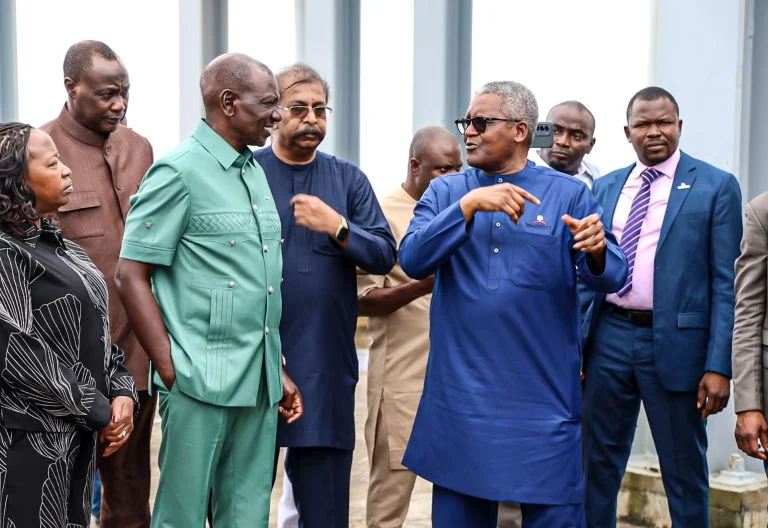
Alhaji, I’m sorry.
People who have achieved your wealth and status are never wrong.
I should not have asked questions. I should not have wondered where the crude will come from, how a 700,000-barrel-a-day refinery would be fed, why the project moved from Tanga to Mombasa and then to Lamu, or what happened to the grand regional proposition with which this story began.
You know these things.

President William Ruto has already explained the attitude I should adopt.
This is a Sh2 trillion investment. It will create about 60,000 jobs. It will transform Lamu. It will supply the region. It will industrialise Kenya.
And the President has made it abundantly clear that he will not allow legal, administrative or bureaucratic obstacles to stand in its way. Kenya, he says, is fully behind the Dangote project.
Who am I to object?
Indeed, I have been thinking about Munoo.
In Mulk Raj Anand’s Coolie, Munoo is a poor boy trying to sell a chicken. He names his price, which the shopkeeper thinks is too high.
Munoo tries to explain. The shopkeeper does not appreciate explanations.
Munoo is beaten until he lowers the price. He is beaten again. Eventually, he learns the great economic law of the poor: the buyer is always right.
And suddenly, I understand.
I, too, had brought a chicken to market.
Only my chicken was a refinery site.
And you, Alhaji, were the buyer.
So I apologise.
I should have understood that the wealthy man has a different relationship with mathematics.
When the investment is Sh2 trillion, the important question is apparently not what it costs.
When the project promises 60,000 jobs, the important question is apparently not when those jobs arrive.
When the refinery is designed for 700,000 barrels a day, perhaps we should not be so vulgar as to ask where all that crude will come from or how consistently the refinery will operate at that capacity.
These, it seems, are questions for people who have not made it.
And besides, the President says his interest is Kenya’s development.
Previous administrations had their own encounters with Dangote’s ambitions in Kenya. This time, the message is different: let the businessman invest and remove unnecessary obstacles from his path.
No demands. No middlemen. No kickbacks. At least, that is how the transaction ought to work.
You arrive with your billions, and Kenya says: Thank you, Alhaji.
Except perhaps I have the transaction backwards.
Maybe it is not Kenya that should be thanking you. Maybe you should be thanking Kenya.
And that, Alhaji, is where my little hypothetical thank-you note comes in.
Suppose, purely for the sake of argument, that someone investing Sh2 trillion decided that the people who made the investment possible deserved a modest expression of gratitude.
Just 0.5 per cent.
A tiny token of appreciation.
Except that 0.5 per cent of Sh2 trillion is Sh10 billion.
Suddenly, the arithmetic becomes rather more interesting, especially with Kenya heading towards another general election.
To be clear, I am not suggesting that you have offered such a payment, or that the President or his government has requested one. The point is precisely the opposite: investments of this scale deserve transparency strong enough to make such questions unnecessary.
So perhaps I should not withdraw all my questions after all.
Where will the crude come from? What infrastructure will Kenya provide? What incentives, concessions or guarantees will the investor receive? What will taxpayers contribute? When will the promised jobs materialise? And what safeguards will ensure that decisions involving trillions of shillings remain firmly in the public interest?
Those are not anti-investment questions.
They are the questions citizens are entitled to ask when the numbers become this large.
Still, Alhaji, I have finally understood my place in the transaction.
I am Munoo Mundu.
I brought the chicken.
You set the price.
I can come back later for my payment.
You may also like
Category: Opinion · Related Topic: William Ruto
Related Video: What Dangote’s proposed Lamu oil refinery could mean for East Africa
Related Explainer: Inside Kenya’s crude supply puzzle as Dangote prepares to break ground in Lamu
About the Author
Kwamchetsi Makokha is a Kenyan journalist, editor, columnist and communications consultant with more than two decades of experience in media and public affairs. A former editor at Nation Media Group, he is a partner at Form & Content Consultancy and a widely published commentator whose work has appeared in the Daily Nation, The EastAfrican, The Elephant and other publications.
 Facebook
 Twitter / X
 WhatsApp
 LinkedIn
 Telegram
 Reddit