
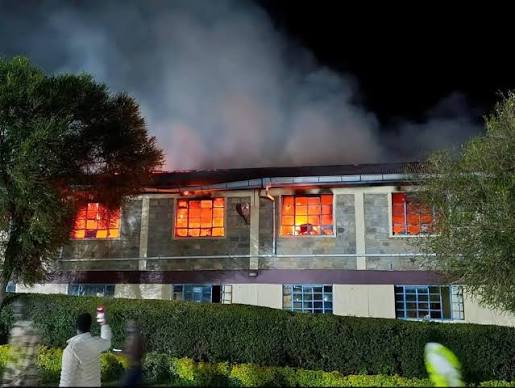
A boys' boarding school in Kericho has been temporarily closed after a night of student unrest in which a dormitory was reportedly set on fire.
Taita Towett Senior School in Kipkelion was shut after the incident on Wednesday night, September 9, 2026, as education officials moved to restore order and assess the damage.
Kericho County Education Director Julius Ngoneshi confirmed the incident on Thursday.
Early accounts indicate that students went on a rampage during the unrest and that a dormitory caught fire.

There were also reports that students attempted to set other parts of the school, including classrooms, on fire. Those accounts had not been independently verified by education authorities at the time of publication.
The cause of the unrest was also not immediately clear.
That is now likely to be a key part of the investigation.
School temporarily closed
The incident forced authorities to intervene as smoke was seen rising from parts of the school.
Images circulating from the scene showed students outside their usual learning environment as the situation unfolded.
Firefighters and other responders were called in to contain the blaze.
The full extent of the damage was yet to be established.
There were no confirmed reports of deaths linked to the incident at the time of publication.
The temporary closure gives education officials time to establish what happened, assess the school's safety and determine when learning can resume.
It also leaves families waiting for information about when students will return and what arrangements will be made for their continued learning.
Another school closure just days earlier
The Kericho incident comes barely a week after Jomo Kenyatta Boys Senior School in Bahati, Nakuru County, was closed indefinitely following another night of student unrest.
The September 2 incident reportedly involved a confrontation after police entered the school while students were taking part in an entertainment session. The circumstances surrounding the police deployment and the subsequent confrontation have been reported differently, and authorities have not publicly established all the details.
The school has experienced repeated disruptions this year.
The latest closure has raised concerns among parents about lost learning time, property damage and the effect of repeated unrest on students, particularly those preparing for national examinations.
The two incidents are separate and there is no evidence that they are connected.
But their timing is significant.
Both have occurred in boarding boys' schools and have resulted in learning being disrupted.
Kenya's school unrest problem is bigger than one school
The latest incident comes months after the Ministry of Education acknowledged a wider problem involving student unrest in senior secondary schools.
In June, Education Cabinet Secretary Julius Ogamba said the Ministry had recorded unrest in 204 senior schools across the country.
However, he stressed that the affected institutions represented less than two per cent of senior schools, meaning the vast majority were operating normally.
The Ministry also said the disturbances were concentrated mainly in boarding schools.
Officials identified several possible factors during their preliminary assessment.
These included leadership problems, examination-related anxiety, poor conditions in some boarding facilities, demanding school routines, peer influence, substance abuse and what the Ministry described as copycat behaviour.
The government has also pointed to demands by some students to leave school early as a factor in several incidents.
But those are broad findings from the national review.
They should not be automatically applied to the Taita Towett incident before investigators establish what triggered the unrest there.
Government promised a deeper investigation
The government has already announced a multi-stakeholder team to examine the causes of student unrest.
Ogamba said the team would include parents, teachers, students, unions and other stakeholders and would gather views from across the country.
The aim is to understand why unrest keeps emerging rather than simply dealing with each incident after it happens.
Ogamba said the team would review the problem and make recommendations on how schools can strengthen dialogue and peaceful relations between learners, teachers, parents and administrators.
The CS has also maintained that genuine student grievances should be heard, but that violence and destruction of school property cannot be accepted as a way of raising complaints.
The government has warned that learners or others found responsible for arson, violence or destruction will face the law.
Calls for action, not another report
The government's task force has also faced criticism from some education stakeholders.
The Education Stakeholders Association of Kenya argued in July that previous investigations had already identified many of the problems behind school unrest and that the priority should now be implementing known solutions.
That criticism raises an important question as fresh incidents emerge.
Kenya has repeatedly investigated school fires, overcrowding, student grievances, safety standards and discipline.
The challenge is turning those findings into changes that students can actually experience inside schools.
That could mean safer boarding facilities, functioning grievance channels, stronger counselling services and school leadership that responds to concerns before they become confrontations.
The Ministry had already directed schools to strengthen safety measures, guidance and counselling and mechanisms for handling learner grievances.
What happens next at Taita Towett?
For now, the immediate focus at Taita Towett is restoring calm and determining the extent of the damage.
Investigators will also need to establish what triggered the unrest and whether any offences were committed.
Until that work is complete, it would be premature to assign blame or claim that one particular grievance caused the incident.
The temporary closure may restore order in the short term.
But it does not answer the larger question.
Why do some student grievances escalate into violence and destruction before adults intervene?
That is the question the education system has been trying to answer for months.
And with another school now temporarily closed, families will want to know whether the lessons from earlier incidents are finally being put into practice.
You may also like
Category: News
Related Video: The tears of a mother - nothing was wrong with my daughter, how did she DlE in school?
Related Explainer: Explainer: Your car burns at a garage: Who pays for the damage?
About the Author
Maureen Onyango is a journalist passionate about storytelling, life coaching and spiritual lessons. She studied at the Kenya Institute of Management and enjoys telling stories that inform, inspire and empower communities.
 Facebook
 Twitter / X
 WhatsApp
 LinkedIn
 Telegram
 Reddit