
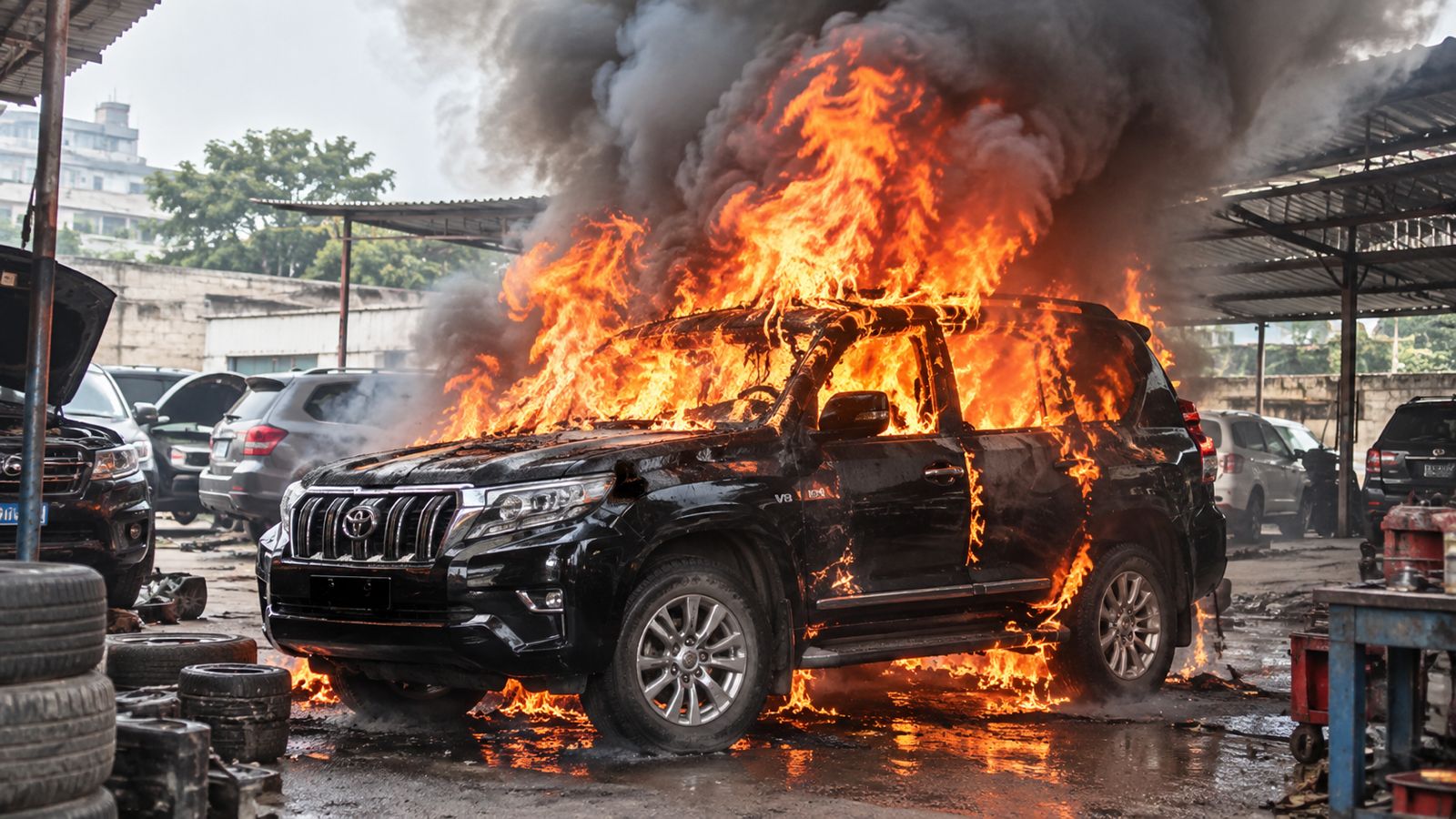
The sight of more than 50 burnt vehicles at garages in Kilimani has left Kenyan motorists asking an uncomfortable question.
If your car catches fire while it is at a garage, who pays?
The answer depends heavily on insurance, the circumstances of the fire and whether anyone can be shown to have been legally responsible.
The Kilimani blaze broke out late on Monday night and spread across three garages around Muringa Road, according to Citizen Digital.
More than 50 vehicles, including expensive models, were destroyed or severely damaged.
Nairobi County emergency teams battled the fire for hours.
No deaths were reported.
Police say the cause has not yet been established and investigations are continuing.
That unresolved cause is important when it comes to compensation.
For motorists with comprehensive motor insurance, fire damage is commonly among the risks that may be covered, subject to the specific terms, exclusions and conditions of the individual policy.
Third-party-only insurance is different.
It primarily protects against liability for injury or damage caused to other people and their property. It does not generally provide the same protection for destruction of the policyholder's own vehicle.
That could leave some owners facing substantial losses.
But what about the garage?
Leaving a vehicle with a mechanic does not automatically make the garage responsible for every disaster that occurs while the car is there.
Liability can depend on whether negligence or another legal basis for responsibility is established.
Investigators will therefore need to determine what started the Kilimani fire and how it spread.
Questions could include how fuel and other flammable materials were stored, what fire-safety equipment was available, whether electrical systems were safe and how quickly the emergency was detected and reported.
Nairobi official Geoffrey Mosiria said the fire took more than four hours to contain because vehicles, petrol and other highly flammable materials were present.
For vehicle owners, documentation now becomes critical.
Insurance companies may require evidence of ownership, policy details, police reports, photographs and documentation showing that the vehicle was at the garage.
Owners should notify their insurers promptly and avoid assuming that compensation is automatic before the claim is assessed.
The Kilimani disaster also exposes another risk.
NTV reported that more than 200 workers depended on the affected facility for their livelihoods.
The losses therefore extend beyond luxury cars to mechanics, spare-parts dealers and other workers.
For every motorist, the fire offers a reason to check something many people ignore until disaster strikes.
Exactly what does your motor insurance policy cover when your car is not in your hands?
Category: Explainers
Related Video: Dolly Parton’s Family Announces Her Passing in Emotional Tribute
Related Explainer: Explainer: Why Kenya is moving hospitals to HMIS and what it means for SHA patients
 Facebook
 Twitter / X
 WhatsApp
 LinkedIn
 Telegram
 Reddit