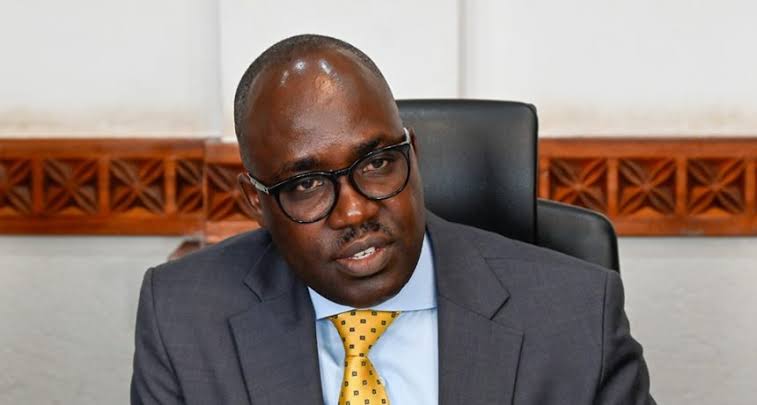
Foreign Affairs PS Korir Sing’Oei says Nairobi has not backed any contender, even as reports say Musalia Mudavadi announced support for Emirati diplomat Lana Nusseibeh.
Kenya’s position in the race to choose the next United Nations Secretary-General has become unclear after Foreign Affairs Principal Secretary Korir Sing’Oei denied that the country had endorsed a candidate, while separate reports said Prime Cabinet Secretary Musalia Mudavadi had announced support for the United Arab Emirates’ nominee.
Sing’Oei said Kenya had not declared its preference for any contender and was continuing to assess the candidates seeking to succeed António Guterres.
“Quite to the contrary, Kenya has not expressed support for any candidate at this point,” he said in a response to a claim posted on X.
He added that Nairobi was following the campaigns and assessing the candidates’ suitability to lead the international organisation.
However, reports published on Monday, 26 October, said Mudavadi had announced Kenya’s support for Emirati diplomat Lana Zaki Nusseibeh while in Moscow. The reports said he cited her experience in multilateral diplomacy and the need to strengthen relations between Africa and the UN.
The two accounts leave an important question unanswered: has Kenya changed its position, or are senior officials communicating different positions on the same diplomatic contest?
No explanation reconciling the statements was found in the official material reviewed for this report. The Ministry of Foreign Affairs would need to clarify whether Kenya has formally endorsed Nusseibeh or whether Sing’Oei’s statement reflects a different stage of the government’s decision-making.
Why the UAE candidate matters
Nusseibeh’s candidacy is recent. The UAE formally nominated her on 21 October, making her a late entrant into a contest that has already involved several rounds of candidate presentations and informal Security Council polling. She previously served as the UAE’s ambassador to the UN and is now a minister of state for foreign affairs.
Her nomination comes as the UN faces pressure to demonstrate that it can respond effectively to international conflicts and humanitarian crises. The next Secretary-General will also have to navigate divisions among the five permanent members of the Security Council, each of which can veto a recommendation for the post.
The contest has attracted candidates from different regions, including former Costa Rican vice-president Rebeca Grynspan, International Atomic Energy Agency chief Rafael Grossi and former Chilean president Michelle Bachelet, whose nomination was later withdrawn. The UN’s official list records the candidates and the countries that nominated them.
Nusseibeh’s diplomatic record is likely to be a central part of her campaign. But her candidacy may also attract scrutiny over the UAE’s regional policies, including allegations concerning its support for Sudan’s Rapid Support Forces. The UAE has denied supporting the paramilitary group. Such issues form part of the wider political environment in which Security Council members will assess candidates.
How the next UN chief will be chosen
The UN Secretary-General is not elected through a direct vote by the world’s population. Under Article 97 of the UN Charter, the Security Council recommends a candidate and the General Assembly appoints the person to the post.
The 15-member Security Council considers candidates in private, including through informal straw polls. A candidate needs at least nine affirmative votes in the Council and must avoid a veto from any of the five permanent members: China, France, Russia, the United Kingdom and the United States.
The General Assembly then makes the formal appointment on the Council’s recommendation. The current selection process includes public candidate dialogues, where nominees outline their priorities and answer questions from member states and civil society.
The process for the next Secretary-General began in November 2025. Guterres’ second term ends on 31 December 2026, with his successor expected to take office on 1 January 2027.
A diplomatic clarification is needed
Kenya’s position matters because support from member states can help shape a candidate’s prospects, even though no single endorsement determines the outcome. For Nairobi, the issue also comes amid growing diplomatic and economic engagement with the UAE.
The two countries have pursued closer cooperation in trade and investment, including through their Comprehensive Economic Partnership Agreement. President William Ruto’s recent meeting with a UAE official has also featured in reports linking bilateral engagement to the UN race. That meeting, on its own, does not establish the reason for any endorsement.
For now, the public record contains conflicting accounts of Kenya’s position. A clear statement from the government would help establish whether Nairobi has formally backed Nusseibeh and explain the apparent difference between the Foreign Affairs PS’s denial and reports of Mudavadi’s announcement.
Until that clarification is made, it would be premature to describe Kenya’s position as settled.
You may also like
Category: News · Related Topic: Kenya Politics
Related Video: What Dangote’s proposed Lamu oil refinery could mean for East Africa
Related Explainer: Kenya’s short rains: What the 2026 forecast means for you
About the Author
Maureen Onyango is a journalist passionate about storytelling, life coaching and spiritual lessons. She studied at the Kenya Institute of Management and enjoys telling stories that inform, inspire and empower communities.
 Facebook
 Twitter / X
 WhatsApp
 LinkedIn
 Telegram
 Reddit