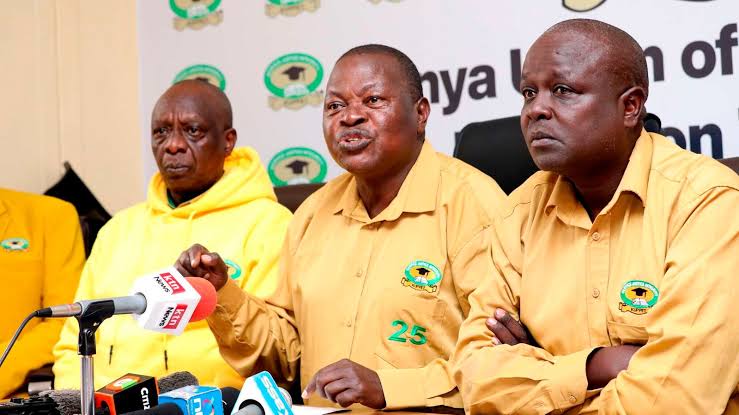
Kenya’s 2026 national examinations could face disruption after the Kenya Union of Post-Primary Education Teachers (KUPPET) threatened to ask its members to withdraw from examination duties over what it says are inadequate allowances.
The warning comes at a sensitive point in the school calendar.
The Kenya Primary School Education Assessment (KPSEA) is scheduled for October 26 to 28, while the Kenya Certificate of Secondary Education (KCSE) cycle begins with oral and practical examinations on October 19 before the written papers start in November.
KUPPET Secretary-General Akello Misori said on Thursday that teachers serving as examiners, supervisors, invigilators and centre managers are not being paid enough for the responsibilities they undertake.

The union has petitioned the Salaries and Remuneration Commission (SRC) to review the payments.
“We want to remind the SRC to be on the frontline to safeguard the rights of the teachers or workers who undertake such projects,” Misori said.
He questioned why professionals handling examination centres could receive less than workers in other occupations.
“Imagine a centre organiser, who is a professional, is being paid below what a construction worker is being paid,” he said.
KUPPET puts exams on the table
Misori said the union could go as far as asking teachers not to take up examination assignments if the issue is not addressed.
“Therefore, going forward, if it is not done, we shall be asking teachers not to undertake the programmes of managing exams, beginning with Kenya Primary School Education Assessment (KPSEA) up to the Kenya Certificate of Secondary Education (KCSE),” he said.
The threat covers some of the most important stages of the national assessment system, including supervision, invigilation, centre management and marking.
KUPPET has said its demand is not simply about increasing pay but ensuring that teachers undertaking additional examination responsibilities are fairly compensated.
The SRC's constitutional mandate includes advising the national and county governments on remuneration and benefits for public officers. The commission says its work is guided by principles including fairness, equity and fiscal sustainability.
There was no immediate indication that the SRC had agreed to the union's demand for a review.
Exams are already on the calendar
The dispute is unfolding with the examination machinery already in motion.
KNEC has published the 2026 timetables and instructions for the major national assessments. The KPSEA rehearsal is scheduled for October 23, followed by the assessment from October 26 to 28.
For KCSE, the first examinations are scheduled for October 19, with oral and practical papers coming before the main written examinations. The written papers begin on November 2, with the examination period ending on November 20.
That leaves little room for prolonged uncertainty over the availability of personnel needed to run the examinations.
KNEC relies on recruited and deployed personnel to administer its examinations, including supervisors, invigilators and other examination officials.
Pay dispute is not new
The latest warning comes after a series of disagreements between teachers' unions and the government over pay and working conditions.
Earlier this month, Education Cabinet Secretary Julius Ogamba said the government was working with teachers' unions to address outstanding grievances, including issues around pay, promotions, housing allowance, medical cover and working conditions.
He also acknowledged the union's proposal to compress some phases of the current collective bargaining agreement, while noting that budget timelines presented a challenge.
The latest dispute, however, focuses specifically on payments for examination work.
KUPPET says teachers should receive remuneration that reflects the additional duties and responsibilities involved in running national examinations.
Union also challenges education Bills
The examination dispute is not KUPPET's only concern.
The union is also objecting to the process being used to push through proposed changes to Kenya's education laws.
Six Bills are currently undergoing public participation, including the Basic Education Bill, 2026, and the Tertiary Education, Placement and Funding Bill, 2026.
Misori argued that legislation should follow an established policy process.
“The current Education Bill being canvassed is being done outside the established law. It is outside the sector plan, outside a known sessional paper. You cannot legislate before developing policy,” he said.
KUPPET has previously called for the public participation process to be suspended, saying more consultation is needed before Parliament proceeds with the proposed changes.
Parliament's Departmental Committee on Education has since extended the public participation exercise to October 2. The additional hearings will cover 16 counties, bringing the exercise to all 47 counties.
The committee has invited members of the public and stakeholders in the affected counties to make oral submissions or submit written memoranda.
For now, the two disputes are unfolding side by side.
The immediate concern for schools and families is whether the disagreement over examination allowances can be resolved before teachers are required to take up their examination assignments.
Neither KNEC nor the government has announced any change to the published 2026 examination timetable.
You may also like
Category: News
Related Video: Beyond Aid: How Japan Is Shaping Kenya’s SME Future | JICA Training Experience
Related Explainer: Kiharu Technical College September Intake 2026: Courses, Skills and New Opportunities
About the Author
Maureen Onyango is a journalist passionate about storytelling, life coaching and spiritual lessons. She studied at the Kenya Institute of Management and enjoys telling stories that inform, inspire and empower communities.
 Facebook
 Twitter / X
 WhatsApp
 LinkedIn
 Telegram
 Reddit