
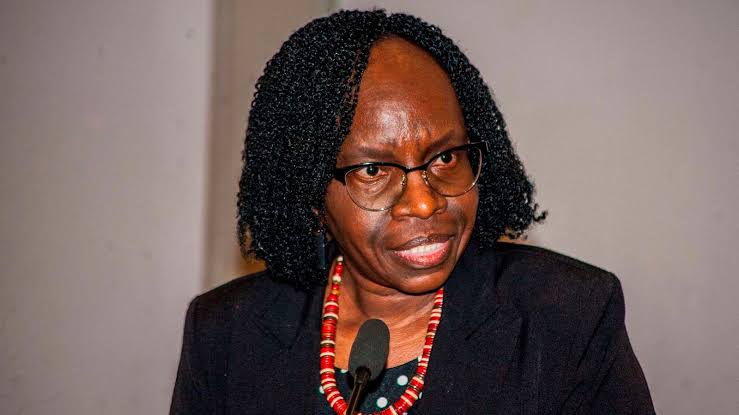
Auditor-General Nancy Gathungu has urged school heads to address financial audit queries directly, as Parliament steps up scrutiny of how public secondary schools manage millions of shillings.
Gathungu’s remarks come amid a growing dispute over school audits, after reports that some principals alleged individuals linked to the audit process demanded between KSh400,000 and KSh1.5 million in exchange for favourable audit outcomes.
The allegations have not been independently established.
The Office of the Auditor-General (OAG) said it takes any concerns about the conduct of its officers seriously and has mechanisms for handling complaints. It has also urged anyone with evidence of misconduct to report it to investigative agencies, including the Ethics and Anti-Corruption Commission (EACC).

But Gathungu said allegations about auditors should not distract from the financial issues already contained in official audit reports.
“We, therefore, urge the School Heads to respond to the audit findings in our reports, as other public entities have been doing, and desist from deflecting attention from the audit issues raised,” she said.
Parliament turns the spotlight on schools
The remarks come as the National Assembly’s Public Investments Committee on Governance and Education examines Auditor-General reports covering schools for the 2020/21 to 2024/25 financial years.
The committee’s mandate includes examining Auditor-General reports and accounts relating to public investments in the education sector.
The scrutiny has put the financial management of some of Kenya’s best-known public secondary schools under an unusually close spotlight.
Among the issues raised are payments made by schools to the Kenya Secondary School Heads Association (KESSHA), additional charges imposed on parents and weaknesses in financial controls.
The Auditor-General has questioned direct payments to KESSHA, arguing that the association is a welfare body for school principals and that its subscriptions should not simply be paid from public school funds.
The parliamentary committee has also questioned how the payments were authorised and accounted for.
At one sitting, MPs said individual schools had transferred millions of shillings to KESSHA. Principals appearing before the committee argued that the money supported joint co-curricular activities such as sports, music and drama.
Parents' contributions also under scrutiny
Another major issue is money collected from parents outside approved school charges.
Some principals have argued that additional contributions were agreed upon by parents or approved by boards of management.
MPs, however, have stressed that parental or board approval does not automatically replace approval required from the Ministry of Education.
Recent committee hearings have included questions over schools charging amounts above the approved fee structure, including money collected through parent support programmes.
The issue matters because a school cannot simply turn a voluntary-looking contribution into a mandatory charge without following the applicable government rules.
The committee has warned that principals could face financial consequences where public money is found to have been spent without the required authority.
What the Auditor-General says it has found
The OAG said it began auditing schools as an independent external auditor in the 2022/23 financial year.
Since then, it says its audits have identified concerns involving financial record-keeping, school funding, enrolment information, expenditure, risk management and compliance with laws and regulations.
The office says its role is not limited to checking whether figures balance.
Under Article 229 of the Constitution, the Auditor-General is required to examine the use and management of public resources and determine whether public money has been applied lawfully and effectively. The office also considers internal controls, risk management and governance systems as part of its audit work.
That makes the current parliamentary hearings more than a dispute over paperwork.
They are also examining whether schools have followed the rules when spending money and whether the systems meant to safeguard public funds are working.
Auditor-General responds to allegations against staff
The OAG's response follows reports in which school principals alleged that people connected to the audit process sought large payments for favourable treatment.
The Standard reported that the alleged demands ranged from KSh400,000 to KSh1.5 million. The principals cited concerns about possible adverse audit findings or delays if the demands were not met. These are allegations by the principals and have not been established as fact.
Gathungu said the office's core values include integrity, credibility, relevance, accountability and independence.
She said complaints about staff conduct should be pursued through the appropriate channels, including independent investigative agencies.
The EACC is among the agencies she identified for such complaints.
That leaves two separate questions before the authorities.
One is whether any person involved in the audit process engaged in misconduct.
The other is whether the financial weaknesses identified in the schools' audit reports can be properly explained and resolved.
One does not cancel out the other.
Public money remains at the centre of the dispute
The OAG has also pointed to a 2022 High Court decision involving the Agricultural Society of Kenya. The court held that a private entity receiving public funds is required to account for their use and that the Auditor-General has a mandate to investigate how such funds are used and report to Parliament.
The principle is important in the current school debate: once public money is involved, questions about how it was spent do not disappear simply because an institution has another justification for the expenditure.
The Auditor-General says its audits are intended to identify weaknesses and help public institutions strengthen controls, comply with the law and improve service delivery.
For school heads now appearing before Parliament, that means the audit findings are likely to remain the central issue even as questions about the conduct of individual auditors are investigated.
The next test will be whether both sets of concerns — the audit findings and the allegations against auditors — are subjected to evidence-based scrutiny.
For parents and learners, the outcome ultimately comes down to a simple question: whether money intended for education is properly accounted for and reaches the services it is meant to support.
You may also like
Category: News · Related Topic: Social Health Authority (SHA)
Related Video: The tears of a mother - nothing was wrong with my daughter, how did she DlE in school?
About the Author
Maureen Onyango is a journalist passionate about storytelling, life coaching and spiritual lessons. She studied at the Kenya Institute of Management and enjoys telling stories that inform, inspire and empower communities.
 Facebook
 Twitter / X
 WhatsApp
 LinkedIn
 Telegram
 Reddit