
Two Royal Air Force pilots who ejected from a training jet moments before it crashed in north Wales are expected to make a full recovery.
The pilots were treated for minor injuries after escaping from the Hawk T2 before it came down near Pencarnisiog on Anglesey on Wednesday.
The RAF said on Thursday that both aircrew were doing well and were in “extremely good spirits”.
“Both pilots are doing well, they are in extremely good spirits and expected to make a full recovery,” the RAF said.

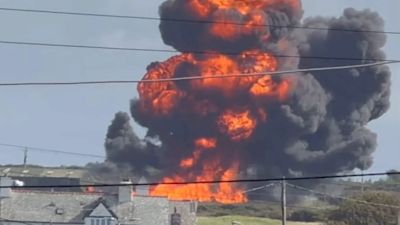
The aircraft crashed shortly after taking off from RAF Valley, a major British military flying training base on Anglesey. Footage shared online showed the jet descending rapidly before hitting the ground and bursting into flames.
Police said there were no reports of other injuries or wider damage.
RAF pauses Hawk flying
The immediate focus has now shifted from the dramatic crash to finding out what went wrong.
The RAF has temporarily suspended flying operations involving its Hawk T1 and Hawk T2 aircraft as a precaution while a formal investigation is carried out.
The service has not given a cause for the crash.
That means it would be premature to attribute the incident to mechanical failure, pilot error or any other factor until investigators have examined the aircraft, flight data and other evidence.
The Ministry of Defence confirmed shortly after the crash that both crew members had ejected and were receiving hospital treatment.
Defence Secretary Wes Streeting said the authorities were investigating “how and why this happened” and wished the pilots a speedy recovery.
Why the suspension matters
The Hawk T2 is not an ordinary training aircraft.
It is used to prepare RAF and Royal Navy pilots for advanced fast-jet flying before they move on to frontline aircraft such as the Eurofighter Typhoon and F-35.
RAF Valley's No 4 Flying Training School is responsible for this stage of fast-jet training. The base also trains aircrew for mountain and maritime operations and houses the RAF Mountain Rescue Service.
The T2 is a two-seat advanced trainer with modern avionics and systems designed to replicate aspects of flying frontline combat aircraft.
It can reach speeds of up to 555 knots and fly as high as 42,000 feet, according to the RAF.
The temporary grounding therefore affects an important part of Britain's military pilot-training system.
Red Arrows also affected
The pause also covers the Hawk T1, the aircraft flown by the RAF's Red Arrows aerobatic team.
The Hawk T1 is a two-seat, transonic jet and has been the Red Arrows' aircraft since 1980. The RAF currently expects the type to remain with the team through the 2029 display season.
The Red Arrows returned to the UK in August after their 2026 United States tour and have continued their international display programme.
However, the grounding does not mean the Red Arrows were involved in Wednesday's incident.
The crashed aircraft was a Hawk T2 operating from RAF Valley. The Red Arrows fly the different Hawk T1 variant.
What happened at RAF Valley?
The aircraft took off from RAF Valley on Wednesday before coming down in the Pencarnisiog area, a short distance from the base.
The two pilots ejected before the jet hit the ground.
Video circulating online appears to capture the moment the aircraft descended towards the ground, followed by a large fireball on impact. The footage should not, however, be treated as evidence of what caused the crash.
Emergency crews attended the scene and the area was closed while the response was under way.
There have been no reports of members of the public being injured in the crash.
RAF Valley's role
RAF Valley has been a military flying station since it opened in 1941.
During the Second World War, it operated as a fighter station and later became a major training base.
Today, its most prominent role is preparing RAF and Royal Navy pilots for advanced fast-jet operations.
The Hawk T2 is central to that work. Trainee pilots move through different stages of instruction before progressing to frontline aircraft.
The RAF has also invested in simulator technology at Valley. In April, the service announced new mixed-reality training systems designed to allow pilots to practise tasks such as formation flying and low-level navigation before undertaking live sorties.
Investigation now under way
For now, the pilots' recovery is the immediate positive development.
The aircraft has been destroyed and the reason it crashed remains under investigation.
The RAF has not indicated how long the Hawk fleet will remain grounded.
The pause gives investigators time to establish whether the incident was linked to the aircraft, its systems, the flight environment or another factor.
Until that work is complete, the dramatic footage of the crash tells only part of the story.
What happened inside the cockpit and to the aircraft in the moments before the pilots ejected will have to be established by the formal investigation.
Category: International
Related Video: Dolly Parton’s Family Announces Her Passing in Emotional Tribute
Related Explainer: Explainer: Your car burns at a garage: Who pays for the damage?
About the Author
Maureen Onyango is a journalist passionate about storytelling, life coaching and spiritual lessons. She studied at the Kenya Institute of Management and enjoys telling stories that inform, inspire and empower communities.
 Facebook
 Twitter / X
 WhatsApp
 LinkedIn
 Telegram
 Reddit