
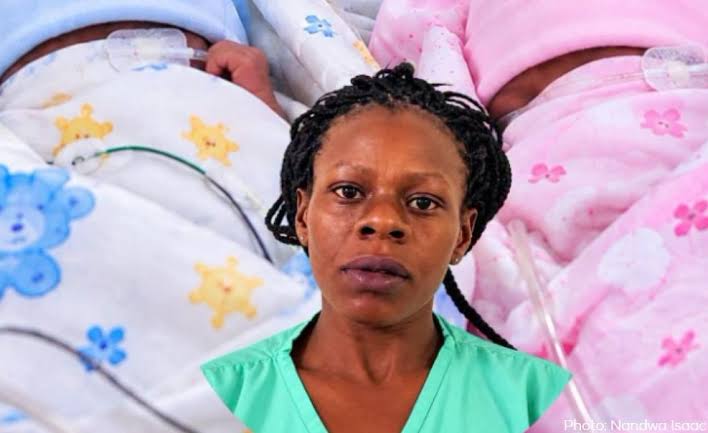
Kenyatta National Hospital (KNH) has confirmed that all five babies born to a Juja mother in a rare quintuplet delivery have died.
The hospital said the newborns were delivered at 25 weeks of pregnancy, placing them in the category of extremely premature babies, and weighed between 630 and 800 grammes.
The confirmation brings an end to uncertainty over the fate of the fifth baby. Earlier reports had said four of the newborns had died while the fifth remained critically ill at KNH. The hospital has now confirmed that none of the five survived.
The babies were born at Thika Level Five Hospital on September 13 and were later transferred to KNH for specialised neonatal care.

A battle from the moment they arrived
In a statement issued on Wednesday, KNH said the babies' gestational age and extremely low weights presented serious medical challenges from admission.
The hospital said a multidisciplinary neonatal team, including neonatologists, nurses and other health professionals, cared for the newborns during their admission.
KNH said the team provided specialised care and continued monitoring as the babies' conditions deteriorated.
The hospital did not suggest that the transfer itself caused the deaths.
Instead, its account centres on the severity of the babies' prematurity and their very low birth weights.
At 25 weeks, the babies were born more than three months before the 37 weeks generally considered full term.
The World Health Organisation classifies a birth before 28 weeks as extremely preterm. It also defines extremely low birth weight as less than 1,000 grammes.
The five babies, therefore, fell into both high-risk categories.
WHO says complications linked to preterm birth remain a leading cause of death among newborns, with survival heavily influenced by access to appropriate newborn care.
From celebration to grief
The deaths come only days after the birth attracted widespread attention across Kenya.
Mercy Kanini, a mother from Juja in Kiambu County, delivered four girls and a boy through normal delivery at Thika Level Five Hospital.
The pregnancy had initially been understood to involve four babies, according to reports. A fifth baby was discovered during delivery.
The birth was described as rare, with the family initially celebrating what appeared to be an extraordinary turn of events.
The babies were subsequently transferred to KNH because they required a higher level of neonatal care.
Earlier reports put their weights between about 600 and 800 grammes, although KNH's latest statement gave the range as 630 to 800 grammes.
Questions now turn to newborn care outside Nairobi
The tragedy has also reignited a wider conversation about the distribution of specialised newborn services in Kenya.
Thika Town MP Alice Ng'ang'a and Juja MP George Koimburi have criticised the Kiambu County Government over the capacity of Thika Level Five Hospital.
The MPs have argued that regional hospitals should have stronger neonatal intensive-care capacity, including equipment and specialised personnel, to manage extremely premature babies closer to where they are born.
Their comments are political criticism, however, and there is no evidence in the available reports establishing that a shortfall at Thika Level Five caused the deaths.
In fact, the babies were stabilised after delivery before being transferred to KNH for specialised care, according to an account from Kiambu County health officials reported by The Star.
The issue nonetheless exposes a difficult question for Kenya's health system: how much specialised newborn care should be available at county level, and how quickly can critically ill babies be moved when a facility cannot provide it?
The Ministry of Health has been working on that wider challenge.
In March 2026, the ministry said it was developing a national healthcare referral policy aimed at improving coordination between facilities and ensuring patients reach the appropriate level of care in time. The proposed policy includes improving emergency response and the movement of patients between facilities.
In August, the ministry also announced plans to establish 10 specialised maternal and newborn health facilities in counties with a high burden of maternal and newborn deaths.
Those plans are part of a much larger challenge.
The WHO's 2025 Kenya annual report says newborn mortality in the country has remained at about 21 deaths per 1,000 live births, with more than 30,000 newborns dying each year. It identifies prematurity, birth asphyxia and sepsis among the major preventable causes.
Family receives support
As the family comes to terms with the loss of all five babies, comedian and philanthropist Eric Omondi has appealed for public support for Kanini.
Omondi has been mobilising assistance for the family through his Sisi Kwa Sisi campaign, including help towards funeral-related expenses.
For Kanini and her family, the story has moved in just three days from the joy of welcoming five children to the grief of losing them all.
For Kenya's health system, the deaths have also placed a difficult question back in the spotlight: whether specialised newborn care is reaching vulnerable mothers and babies quickly enough, wherever they are born.
You may also like
Category: News
Related Video: Dolly Parton’s Family Announces Her Passing in Emotional Tribute
Related Explainer: EXPLAINER: How can one mother give birth to five babies? The science behind Kenya’s rare quintuplets
About the Author
Maureen Onyango is a journalist passionate about storytelling, life coaching and spiritual lessons. She studied at the Kenya Institute of Management and enjoys telling stories that inform, inspire and empower communities.
 Facebook
 Twitter / X
 WhatsApp
 LinkedIn
 Telegram
 Reddit