
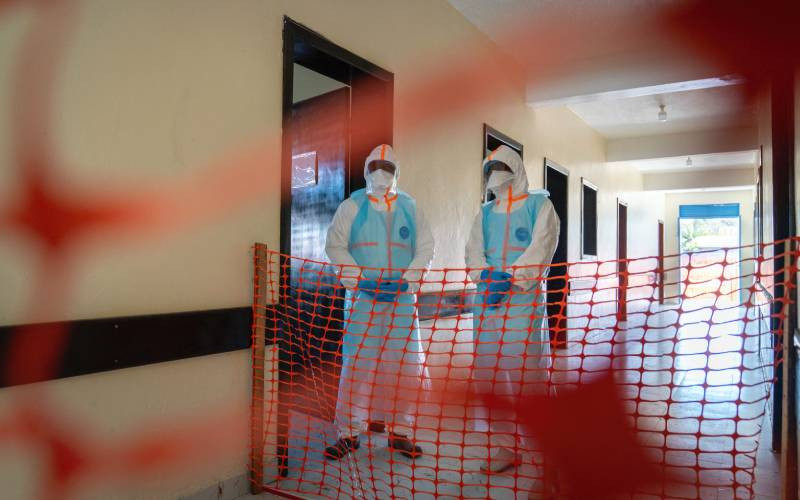
Nearly seven in 10 Kenyans oppose a proposed US-linked Ebola facility in Laikipia, according to a new national survey.
But behind the overwhelming opposition is a more fundamental problem: many Kenyans still do not appear to have a clear picture of what was actually supposed to be built at Laikipia Air Base, who it was intended to serve and whether people infected with Ebola would be flown into the country.
The TIFA Research survey released on September 9 found 69% of respondents opposed the proposed facility. Among those who viewed it negatively, 28% believed it was primarily intended to serve US interests and foreign patients, while others raised concerns about corruption, secrecy and public safety.
Those fears have already spilled onto the streets. Hundreds demonstrated in Nanyuki in June demanding that the project be abandoned.

So, was Kenya really preparing to import Ebola patients from abroad?
The answer is more complicated.
What was America actually proposing?
The original US proposal was for a 50-bed quarantine facility at Laikipia Air Base, according to US officials cited by Reuters and other international media.
Its initial purpose was particularly controversial.
US officials told Reuters in May that Washington was discussing with Kenya a facility where American citizens potentially exposed to Ebola while working in the Democratic Republic of Congo could be quarantined. It was expected to be staffed by members of the US Public Health Service.
There is an important distinction here.
Being exposed to Ebola is not the same as being infected with Ebola.
Initial US descriptions said the facility would accommodate people who had potentially been exposed but were still asymptomatic, rather than deliberately transporting confirmed, seriously ill Ebola patients into Kenya.
That distinction has often been lost in the political argument.
But Kenya's government subsequently described a considerably broader facility.
Health Cabinet Secretary Aden Duale told Parliament in June that the proposed Ebola Treatment and Isolation Unit would form part of a network of similar facilities and would be jointly run by Kenya and the US, with the Kenya Defence Forces and Ministry of Health involved.
That difference between the initial US description and the Kenyan government's broader explanation helps explain some of the public confusion.
Was it only for Americans?
This is another area where the story changed.
Reuters reported that the initial US discussions concerned Americans exposed to the outbreak in the DRC. But Kenya had not approved an Americans-only arrangement and wanted any facility to be available to all nationalities.
Duale subsequently told Parliament that Kenya's Ebola isolation infrastructure would not be reserved for foreigners.
“A Kenyan citizen, a foreign national, a refugee, a diplomat, an expatriate or a traveller would be managed according to the same public health principles,” he said.
The government also pointed to Kenyans working in countries affected by Ebola, including businesspeople and approximately 450 specialised KDF personnel serving in the DRC under the MONUSCO peacekeeping mission.
The argument was that Kenyans themselves could be exposed abroad and require quarantine after returning home.
Would infected Ebola patients be brought to Kenya?
This is the question at the centre of much of the fear.
The original US proposal was framed around potentially exposed but asymptomatic people, not a programme to fly confirmed Ebola patients into Kenya for treatment.
However, the Kenyan government's later description referred to an “Ebola Treatment and Isolation Unit” and said patients would be managed according to clinical need and public-health protocols.
That ambiguity mattered.
If the facility was strictly for asymptomatic contacts, its function and risk profile would differ from a treatment centre receiving symptomatic, confirmed Ebola patients.
The High Court subsequently ordered the government to disclose the agreements, health and biosafety assessments, regulatory approvals and operational protocols associated with the project.
Those documents are crucial because they can establish exactly what categories of patients the facility was designed to receive.
Why Laikipia?
The proposed location was inside Laikipia Air Base near Nanyuki.
A military airbase offers obvious logistical advantages for receiving and controlling the movement of people being medically evacuated. It also allows tighter security and access control than an ordinary civilian facility.
But the location generated its own concerns.
The Laikipia County Government opposed the project, arguing that it had not been adequately consulted on site selection, risk assessments or emergency planning.
It also raised concerns that schools operate within the military installation and questioned whether sufficient child-safety assessments and evacuation planning had been undertaken.
The county further warned that the controversy could damage tourism around Nanyuki and Laikipia.
These are not simply questions about whether Ebola can be contained scientifically. They concern whether the government followed the appropriate process before choosing where such a facility should operate.
Could the facility cause an Ebola outbreak in Kenya?
There is no evidence that merely having a properly designed quarantine facility inevitably causes an Ebola outbreak.
The US Embassy maintained that the proposed bio-isolation facility would not expose surrounding communities to Ebola and said appropriate health-security protocols would be applied.
But critics argued that the government had not initially provided enough information to allow the public to independently assess those assurances.
Laikipia County itself said decisions involving a high-risk infectious disease required transparency, scientific assessment, emergency preparedness and meaningful consultation with the affected community.
That distinction is important.
Opposing inadequate planning or demanding evidence of containment standards is not the same as claiming that an Ebola facility will automatically release the virus into the community.
Why did the courts intervene?
The dispute quickly became a constitutional and legal battle.
The Law Society of Kenya and Katiba Institute challenged the project, raising concerns about public participation, transparency, public health and the agreements underlying the proposed facility.
The High Court stopped its establishment and ordered the government to disclose key documents, including biosafety assessments and operational protocols.
The controversy intensified when questions emerged over whether work had continued despite the court orders.
On June 23, Duale ordered construction suspended after a court found him in contempt for allowing construction to continue despite an earlier order halting the project. He apologised to the court, which accepted his apology and took no further action against him.
That history helps explain why the controversy became about much more than Ebola.
It became a debate about transparency, public participation and whether the government could be trusted to disclose the full terms of a sensitive agreement with a foreign government.
Then came reports that Americans had already been quarantined
The controversy took another turn in August.
The Associated Press reported allegations by activists that seven American humanitarian workers returning from the DRC had been quarantined in military tents at Laikipia Air Base despite the existing court orders.
Samaritan's Purse confirmed that workers were being quarantined, although it did not publicly identify their location, according to AP.
The allegations intensified questions about what exactly was happening at the airbase and whether the court orders were being observed.
They also made the debate far more difficult for the government to contain through assurances alone.
America has committed millions to Kenya's Ebola preparedness
The dispute over Laikipia should not be confused with the wider US-supported Ebola preparedness programme in Kenya.
The US subsequently announced $13.5 million, reported locally at about Sh1.9 billion, to strengthen Kenya's ability to prevent, detect and respond to Ebola.
The programme includes disease surveillance, laboratory capacity, healthcare worker training, emergency response, screening at border points and risk communication.
More than 800 laboratory professionals had been trained in biosafety, biosecurity and testing for viral haemorrhagic fevers, while US-supported laboratories and mobile testing facilities were also involved in preparedness efforts.
Kenya has good reason to prepare.
It is a major transport and commercial hub with extensive movement between East and Central Africa, meaning an outbreak elsewhere in the region can create genuine risks even if Kenya never deliberately receives a foreign patient.
The Ministry of Health has previously stressed that Kenya had no confirmed Ebola cases while strengthening surveillance and preparedness.
Why do seven in 10 Kenyans oppose it?
The TIFA results suggest the government has a substantial trust problem.
The survey involved 2,048 adults interviewed face-to-face across Kenya between June 13 and 22 and carried a national margin of error of approximately 2.18 percentage points.
Some respondents believed the facility primarily benefited the United States. Others feared bringing exposed foreigners into Kenya, while another group cited corruption, secrecy and lack of transparency.
The results suggest that opposition cannot simply be dismissed as ignorance about Ebola.
There are at least two separate issues.
One is scientific: Can people exposed to Ebola be quarantined safely at a properly designed Kenyan facility without creating unacceptable risks to surrounding communities?
The other is political and constitutional: Did the government adequately consult Kenyans, disclose the agreement, explain why Laikipia was selected and demonstrate that the necessary safeguards were in place?
Those are different questions.
And answering the first does not make the second disappear.
The unanswered question
The government can argue that Kenya needs Ebola preparedness. Few would dispute that a country surrounded by extensive regional travel needs the capacity to detect, isolate and treat dangerous infectious diseases.
The US can also argue that controlled quarantine is safer than allowing potentially exposed travellers to move freely.
But the Laikipia controversy demonstrates what happens when a technically complex public-health project is announced before the public believes it has been given enough information about it.
That vacuum gets filled by fear, speculation and politics.
The new TIFA numbers suggest the damage has already been substantial: nearly seven out of every 10 Kenyans surveyed oppose the project.
The government therefore faces a more difficult question than whether an Ebola quarantine facility can be operated safely.
It must explain why Kenyans should trust it to operate one.
You may also like
Category: News
Related Video: Dolly Parton’s Family Announces Her Passing in Emotional Tribute
Related Explainer: Fact Check: Did elephants save people during Nepal’s floods?
 Facebook
 Twitter / X
 WhatsApp
 LinkedIn
 Telegram
 Reddit