
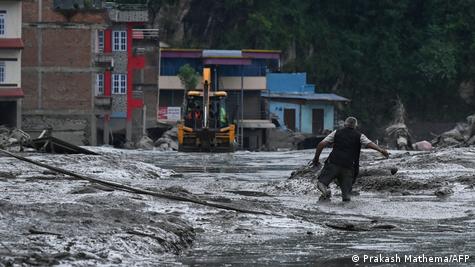
NAIROBI, Kenya — The deadly Himalayan disaster that swept through parts of Nepal and Tibet last month was not simply a flood.
It began high on the mountain.
A huge section of rock and glacier ice broke away from Langtang Lirung in Nepal on August 26. The collapse sent an enormous debris flow into the valley, triggering devastating floods downstream.
Now, scientists say human-driven climate change likely helped create the conditions that made the collapse possible.

A new rapid assessment by the World Weather Attribution (WWA) found that rising temperatures had thinned glaciers, thawed permafrost and increased meltwater around the unstable mountain slope.
But researchers stressed that climate change was not the only cause.
The disaster resulted from several factors coming together, including geological weaknesses and possible damage left by the magnitude 7.8 earthquake that struck Nepal in 2015.
“There’s absolutely no doubt that human-induced climate change played a role here in the preconditioning of the disaster,” said Friederike Otto, a climatologist at Imperial College London and a co-author of the assessment.
A mountain already under pressure
The WWA researchers describe the event as a chain of hazards rather than a single disaster.
Around two square kilometres of rock and glacier ice collapsed from the mountain at an altitude of about 5,150 metres.
The falling mass then transformed into a fast-moving debris flow before becoming a powerful flash flood further downstream.
The US Geological Survey said the initial slope failure released energy equivalent to a magnitude 5.2 earthquake. The debris and flood travelled about 100 kilometres.
WWA researchers put the energy released by the collapse at roughly the equivalent of a magnitude 5.5 earthquake, reflecting a different scientific assessment of the event.
The force of the collapse was therefore not just a result of water.
Rock, ice, mud and sediment were swept into river valleys at enormous speed, destroying homes and damaging roads, bridges, hydropower facilities and other infrastructure.
How warming may have weakened the slope
Scientists say the mountain had been changing for years.
Glaciers in the area have been losing ice. Permafrost — ground that normally remains frozen for long periods — has also been thawing.
That matters because frozen ground can help bind rock together. As it warms and weakens, slopes can become more vulnerable to failure.
The WWA study found that temperatures in the area during July and August were about 1.5°C higher because of human influence on the climate.
Researchers also found evidence of long-term glacier thinning in the region.
The result was a mountain environment already under stress before the collapse.
Heavy snowfall late last year added another complication. As temperatures rose, the accumulated snow and ice contributed to meltwater around the mountain.
The researchers say these factors may have interacted with the underlying geology and increased instability.
The 2015 earthquake may have left a weakness
Climate change does not explain everything.
The Langtang area was badly affected by Nepal's devastating 2015 earthquake.
That earthquake itself triggered a major rock-and-ice avalanche in the Langtang region.
Researchers say the earlier earthquake may have weakened the underlying rock and left fractures that contributed to the mountain's vulnerability years later.
Walter Immerzeel, a mountain hydrologist at Utrecht University and a co-author of the new study, described the area as a particularly vulnerable geological slope.
But the exact contribution of the 2015 earthquake cannot be established with certainty.
That distinction matters.
The scientists are not saying that warming directly caused a particular crack in the mountain to fail on August 26. Their argument is that years of warming altered the environment in ways that made an already unstable landscape more susceptible to collapse.
More than 1,400 dead as missing toll rises
The scale of the disaster has continued to emerge weeks after the initial floods.
Nepal's authorities revised the number of missing people sharply upwards on September 16, from 5,179 to 6,150, after collecting and verifying information from affected districts.
The Nepalese death toll had reached 1,403, according to the latest figures reported by the Associated Press.
The combined toll from Nepal and the affected area across the border was reported at about 1,446 deaths and 6,669 missing by international news agencies.
The continuing search has been complicated by destroyed roads, heavy sediment and damaged infrastructure.
At least 13 hydropower plants were damaged, while workers and residents were trapped in some areas cut off by the floods.
Scientists caution against a simple climate explanation
The WWA assessment provides an important new piece of evidence, but it is not the final word on precisely how the disaster unfolded.
The report has not yet gone through conventional peer review in a scientific journal.
Other experts have welcomed its findings while stressing the limits of attributing a complex mountain collapse to one factor.
Simon Cook, a glacier expert at the University of Dundee, said the assessment provided useful evidence that warming was an important part of the chain of events, while cautioning that scientists still do not know every detail of how the collapse developed.
That uncertainty is important because high-mountain disasters are difficult to predict.
Glaciers, frozen ground, rock structures, snowfall, rainfall and earthquakes can interact in ways that are difficult to model.
A warning for Himalayan communities
The disaster has nevertheless sharpened concerns about the risks facing communities living below rapidly changing mountain environments.
The Himalayas are warming, while glaciers are retreating and permafrost is becoming increasingly unstable.
That does not mean every glacier will collapse or every flood can be attributed to climate change.
It does mean the physical conditions in some high-altitude areas are changing.
And communities living downstream have little room for error.
Nepal has already appealed for greater international support over the losses caused by the disaster.
The United Nations said earlier this month that Nepal contributes very little to global greenhouse gas emissions but is facing severe consequences from a changing climate. It said the country had approached the UN Loss and Damage Fund for assistance.
That argument is likely to receive a global audience next week.
Nepal's Prime Minister Balendra Shah is due to take part in the UN General Assembly's high-level week in New York, where climate action and climate justice will be among the issues on the international agenda. The UN's 81st General Assembly high-level week runs from September 22 to 29, with a dedicated high-level meeting on climate action and a just transition scheduled for September 23.
For Nepal, the disaster has become more than a national tragedy.
It is also a stark example of the challenge facing mountain communities as a warming climate interacts with natural geological hazards.
The scientists' message is not that climate change created the mountain.
It is that a mountain already vulnerable to collapse may have been made more unstable by a warming world.
You may also like
Category: International
Related Video: Beyond Aid: How Japan Is Shaping Kenya’s SME Future | JICA Training Experience
Related Explainer: Fact Check: Did elephants save people during Nepal’s floods?
About the Author
Maureen Onyango is a journalist passionate about storytelling, life coaching and spiritual lessons. She studied at the Kenya Institute of Management and enjoys telling stories that inform, inspire and empower communities.
 Facebook
 Twitter / X
 WhatsApp
 LinkedIn
 Telegram
 Reddit