
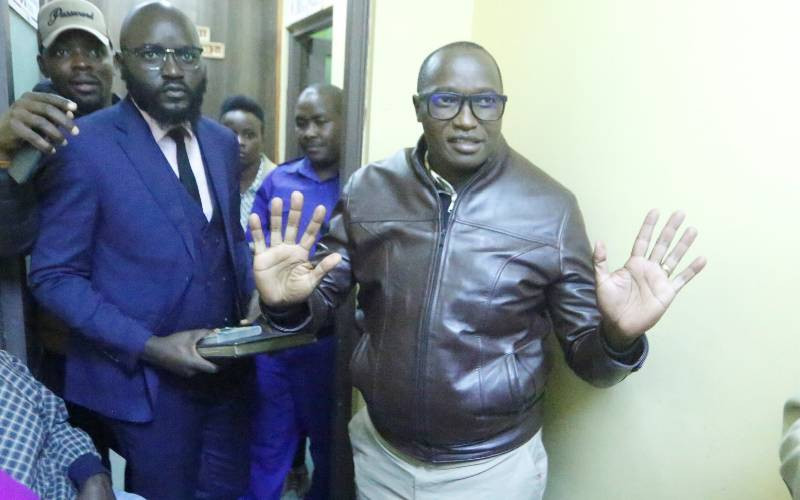
A standoff is unfolding at Kamukunji Police Station after opposition leaders and lawyers demanded the release of Mukurweini MP John Kaguchia, hours after his lawyers said the High Court had granted him police cash bail of Sh100,000.
Several MPs, led by Kipipiri MP Wanjiku Muhia, have gathered at the station demanding answers over why Kaguchia remains in custody despite the reported court directive.
The dispute has now shifted beyond Kaguchia's arrest itself to a more fundamental question:
What happens when police are accused of failing to implement a court order directing the release of a detained politician?

Kaguchia was arrested on Monday over alleged electoral offences and incitement. His continued detention has since attracted the attention of opposition leaders, lawyers and lawmakers from the Mt Kenya region.
Gachagua warns police over court order
Democracy for the Citizens Party (DCP) leader Rigathi Gachagua said on Facebook that the High Court had directed the Officer Commanding Station at Kamukunji Police Station to release Kaguchia immediately upon payment of the Sh100,000 police bail.
According to Gachagua, the order had been served at the station but the officer in charge had not acted, instead waiting for instructions from senior officers.
Gachagua warned that failure to comply with a court order could expose the officer to contempt proceedings.
The former Deputy President also referred to the ongoing murder case involving a former OCS of Central Police Station, using it as a warning to officers against carrying out instructions they believe may be unlawful.
Those claims have not, from the information available in the original report, been independently established. The key issue now is whether the court order was validly issued, properly served and whether the conditions attached to Kaguchia's release have been met.
MPs refuse to leave station
Several MPs from the Mt Kenya region have remained at Kamukunji Police Station, insisting that Kaguchia should be released.
The lawmakers have questioned why he remains in custody if the reported bail order has already been served.
They also claimed that when they sought information about the MP's detention, they were directed to Central Police Station.
The confrontation has turned the police station into the latest flashpoint in an increasingly political dispute over the arrest.
Why the case matters
Kaguchia's case is significant because it raises two separate questions.
The first concerns the allegations that led to his arrest: what electoral offences and statements are investigators relying on, and what evidence supports the allegations?
The second concerns the detention itself: has the state complied with the court's reported bail order?
Those questions should not be conflated.
A person can be arrested and investigated over alleged offences while still retaining legal rights governing detention and bail.
That distinction is particularly important in politically sensitive cases, where claims of selective enforcement can quickly become part of the wider political contest.
Opposition cries selective enforcement
Opposition leaders have accused investigative agencies of selectively applying the law to government critics.
They argue that politicians who have made controversial statements in the past have not always faced similar action.
That claim remains a political allegation and requires evidence before it can be treated as an established fact.
But it raises a legitimate question for investigators and the authorities:
Are similar cases being treated consistently, regardless of whether the individuals involved support or oppose the government?
A comparison of previous cases involving alleged incitement and electoral offences could provide a clearer answer.
The unanswered questions
The Kaguchia case now leaves several issues that authorities will need to clarify:
- What specific allegations led to his arrest?
- What evidence are investigators relying on?
- What exactly did the High Court order?
- When and how was the order served on the police?
- Were all conditions for release fulfilled?
- Why was Kaguchia still in custody after the reported bail order?
- Did the OCS seek clarification from senior officers or the court?
- Has the Director of Public Prosecutions taken a position on the case?
- Are other politicians accused of similar offences being investigated or prosecuted under the same standards?
These questions are more important than the political confrontation outside the police station.
From a political confrontation to a rule-of-law test
Kaguchia's arrest is rapidly becoming more than another political confrontation ahead of the 2027 elections.
It is developing into a test of how Kenya's institutions respond when politics, policing and judicial authority collide.
For the opposition, the case provides another opportunity to challenge what it describes as selective enforcement.
For the police, it presents an opportunity to demonstrate that investigations involving politicians are conducted according to evidence and established procedure rather than political considerations.
And for the Judiciary, the case highlights the importance of ensuring that its orders are understood and implemented by the agencies responsible for enforcing them.
The immediate issue is therefore simple:
If the High Court ordered Kaguchia's release on police bail and the conditions were fulfilled, why is he still in custody?
The answer to that question — rather than the political noise surrounding the arrest — could determine the real significance of the Kaguchia case.
You may also like
Category: Politics · Related Topic: 2027 Elections
Related Video: Human Ladder Reaches Dangerous Heights as Climbers Keep Going
Related Explainer: Explainer: What happened to milk in Kenya?
 Facebook
 Twitter / X
 WhatsApp
 LinkedIn
 Telegram
 Reddit