
Kenya's High Court has upheld a law restricting retired presidents from holding leadership positions in political parties beyond six months after leaving office.
The ruling could have renewed political significance ahead of the 2027 General Election, particularly because former President Uhuru Kenyatta remains active in Jubilee Party politics.
Justice Lawrence Mugambi, in a judgment delivered on Monday, September 14, dismissed a constitutional challenge to Section 6 of the Presidential Retirement Benefits Act.
But the court did not bar former presidents from politics.

They can still belong to political parties and take part in political activities. What the law restricts is their continued occupation of formal party leadership positions after the six-month window.
Justice Mugambi said the distinction was important.
“A reading of Section 6(1) is clear,” the judge said, according to the judgment reported by Citizen Digital. “It does not forbid the retired President from being a member of a political party.”
The restriction, he said, concerns holding a leadership role beyond the six-month period.
Why the court upheld the restriction
The case was brought by Peter Odhiambo Agoro, Paul Muiruri Kiguathi and Damon Onyango.
They argued that the law unfairly singles out former presidents and limits rights protected by the Constitution, including political participation, freedom of association and equality.
The court rejected that argument.
Justice Mugambi found that constitutional political and association rights are not absolute. Parliament can limit such rights where the restriction is lawful, reasonable and justifiable in a democratic society.
The judge also considered why Parliament introduced the restriction.
The Presidential Retirement Benefits Act was enacted in 2003. The court found that one of the concerns behind the law was preventing former presidents from retaining political power through party structures or successors after leaving State House.
That concern, the judge concluded, has not disappeared.
“I do not think that this provision has outlived its usefulness,” Mugambi said, according to Citizen Digital.
In other words, the court viewed the six-month limit not simply as a restriction on an individual former president, but as a safeguard around the transfer of political power.
What the law actually says
Section 6(1) of the Act states that:
“A retired president shall not hold office in any political party for more than six months after ceasing to hold office as president.”
The law therefore does not amount to a blanket political retirement.
A former president can remain a party member.
They can express political views.
They can participate in political activities.
The legal line concerns formal party office.
The Act also links political-party activity to retirement benefits. Section 4 allows Parliament, through a two-thirds vote, to withdraw or reduce benefits where a retired president has acted contrary to the political restrictions in the law.
That provision is now particularly relevant because there have been separate political efforts to question Uhuru Kenyatta's retirement benefits.
Why Uhuru Kenyatta is at the centre of the debate
Kenyatta left State House in September 2022.
Since then, he has remained involved in opposition politics.
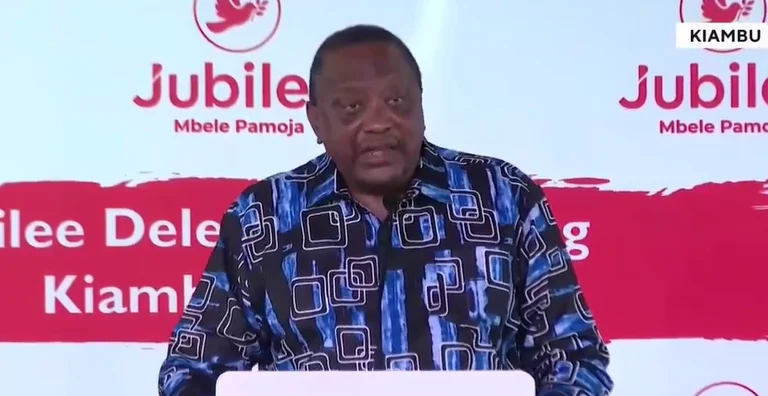
He is also the leader of the Jubilee Party. In January 2026, Jubilee's National Executive Council met under his leadership and approved changes to the party's senior structure ahead of the 2027 election.
In May, Kenyatta also chaired a Jubilee delegates' meeting in Kiambu, where he spoke about the party's direction ahead of the next election.
He has also remained involved in broader opposition discussions.
In August, for example, the Daily Nation reported that Kenyatta was expected to chair an Azimio Coalition Council meeting as opposition parties explored ways of working together ahead of 2027.
That makes Monday's ruling more than a legal footnote.
It comes at a time when the role of former presidents in active politics is already becoming a major political question.
Government allies have already challenged Uhuru's political role
The ruling also comes against the backdrop of attempts by some government-aligned politicians to challenge Kenyatta's continued political involvement.
In May, Nandi Senator Samson Cherargei filed a motion seeking the withdrawal or reduction of Kenyatta's retirement benefits, alleging that the former president had breached the political restrictions in the law.
Other government figures have made similar calls.
Kakamega Deputy Governor Ayub Savula has also argued that Kenyatta should lose his retirement benefits over alleged continued political activity.
Those are political allegations, however, and should not be confused with a judicial finding that Kenyatta has violated the law.
The High Court's latest judgment dealt with the constitutionality of Section 6 itself. It did not, on the material available, determine a separate case declaring Kenyatta personally in breach of the provision.
That distinction matters.
What happens next?
The ruling settles one question: the six-month restriction remains legally valid.
It does not automatically answer every question about how the law should be enforced against an individual retired president.
That could become increasingly important as the 2027 election approaches.
Kenyatta's supporters have previously defended his right to engage in public and political affairs, while critics argue that a former head of state should respect the limits attached to the office and its retirement benefits.
The law itself creates a difficult balance.
Kenya's former presidents remain citizens with political rights.
But they also occupy a unique place in the country's political system.
The court has now made clear that, in its view, Parliament was entitled to place a boundary between being politically active and formally controlling a political party.
As the 2027 contest takes shape, that boundary is likely to face its biggest practical test yet.
You may also like
Category: News · Related Topic: 2027 Elections
Related Video: Human Ladder Reaches Dangerous Heights as Climbers Keep Going
Related Explainer: Explainer: What happened to milk in Kenya?
About the Author
Maureen Onyango is a journalist passionate about storytelling, life coaching and spiritual lessons. She studied at the Kenya Institute of Management and enjoys telling stories that inform, inspire and empower communities.
 Facebook
 Twitter / X
 WhatsApp
 LinkedIn
 Telegram
 Reddit