
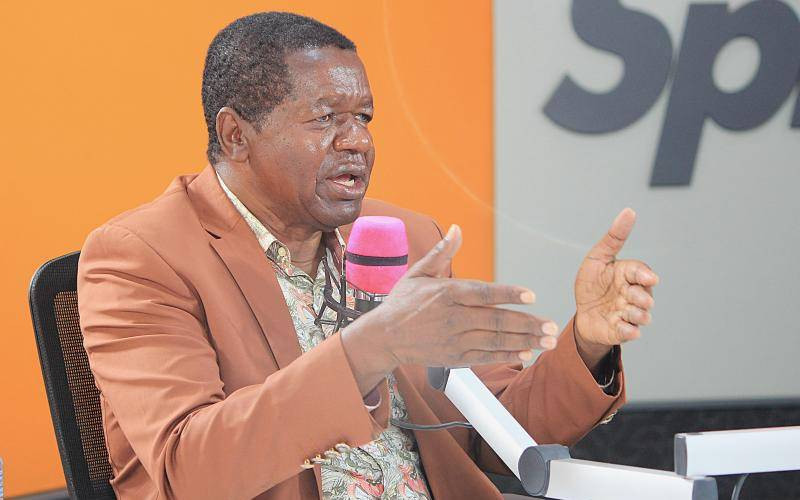
Former electoral commission chief James Oswago has reopened debate over Kenya’s political fixation with presidential second terms, arguing that re-election should not be treated as an automatic entitlement for an incumbent president.
Oswago, a former chief executive of the Independent Electoral and Boundaries Commission (IEBC), has increasingly questioned Kenya’s political and electoral architecture as the country moves towards the 2027 General Election.
His interventions come amid political rhetoric around President William Ruto serving a second term, including controversial remarks by some of the President’s allies suggesting his re-election is inevitable.
The constitutional position, however, is straightforward: Kenya’s presidency is decided by voters at an election. A president may serve a maximum of two terms, but the Constitution does not guarantee an incumbent a second one.

Oswago questions the assumption of an automatic second term
Oswago has argued that Kenya needs to interrogate the political culture that has developed around incumbency and presidential elections.
His broader argument is that the enormous power and political value attached to the presidency has made elections increasingly high-stakes contests in which losing is viewed as exclusion from government.
In an earlier interview, Oswago described Kenya as having created devolution while retaining what he characterised as an overly powerful presidency.
“Unless Kenyans restructure the executive, we will not progress,” he said, arguing that alternative centres of executive power could reduce the winner-takes-all character of presidential contests.
He suggested that an office such as prime minister could provide a counterweight within the executive, although such a change would require constitutional and political processes beyond the electoral commission.
Oswago has also advocated greater use of proportional representation, arguing that Kenya’s existing electoral model contributes to political polarisation. These are his proposals for reform, rather than provisions of the current constitutional system.
Can a Kenyan president lose after one term?
Yes.
Kenya’s Constitution limits the president to a maximum of two terms, but it does not establish a minimum two-term presidency.
An incumbent seeking re-election must contest the presidential election and satisfy the same constitutional electoral thresholds required to be declared president.
The political question is more complicated.
Oswago has previously acknowledged that defeating an incumbent president in Kenya is difficult. Asked in an interview whether it was easy for a sitting president to lose an election, the former IEBC chief answered “No.”
That observation is different from saying an incumbent cannot lose.
Kenya's experience under the 2010 Constitution has so far seen both presidents who completed a first term — Uhuru Kenyatta and William Ruto's current presidency before the 2027 vote — either win re-election in Kenyatta's case or remain eligible to seek it in Ruto's case.
The 2027 election will therefore again test the distinction between constitutional eligibility for a second term and a political assumption that an incumbent is entitled to one.
‘Two terms’ rhetoric raises questions ahead of 2027
The issue has gained additional significance because some government-allied politicians have publicly described a second Ruto term as virtually assured.
Kapseret MP Oscar Sudi and Wajir Woman Representative Fatuma Jehow have previously made controversial remarks about adding or “stealing” votes if necessary to secure Ruto’s re-election.
Following such statements, IEBC warned political actors against rhetoric that could undermine public confidence in elections.
The commission said it would safeguard its independence and impartiality and remained committed to conducting free, fair and credible elections in accordance with the Constitution and electoral laws.
The politicians' statements are not evidence that votes will actually be manipulated. But they generated criticism because confidence in the electoral process depends partly on voters believing that the outcome will be determined by ballots rather than predetermined political arrangements.
Oswago says the problem goes beyond IEBC
Oswago’s wider argument is that Kenya places too much responsibility for credible elections on the electoral commission while leaving structural political problems unresolved.
“Technically, they can run a good election. But if the rules outside the commission are flawed, the outcome will still be contested,” he said in an earlier interview.
He has also warned that Kenya risks repeating previous election problems unless reforms are undertaken before 2027.
Among his concerns are the cost of elections, institutional preparedness and the structure and tenure of the electoral commission.
IEBC has sought Sh74.8 billion for the three-year electoral cycle, against a reported Treasury allocation of Sh41.3 billion, leaving a substantial funding gap.
Oswago has argued that election reform should therefore extend beyond what happens on polling day.
Incumbency remains a major factor
Kenya is not unique in confronting questions about incumbent advantage.
Sitting presidents generally enter elections with greater public visibility and an established political organisation. In Kenya, debate also frequently focuses on the relationship between incumbency and access to the machinery and visibility of government.
That makes institutional independence particularly important.
The Constitution establishes IEBC as an independent commission, and the credibility of the 2027 contest will depend partly on whether competing candidates and voters believe the electoral administration operates impartially.
Oswago has previously argued that the country's political culture makes defeating an incumbent difficult while simultaneously warning against treating electoral outcomes as predetermined.
2027 will ultimately be decided at the ballot
President Ruto, elected in August 2022, is constitutionally eligible to seek another term in 2027.
But eligibility is not the same as entitlement.
Kenyan voters will determine the presidential election subject to the constitutional thresholds and electoral process.
That distinction is likely to become increasingly important as campaigning intensifies.
Political slogans such as “two terms” may be effective mobilisation tools for supporters, but constitutionally, Kenya does not elect presidents for an automatic ten years.
It elects them for one term at a time.
And that is the central issue raised by Oswago’s intervention: a second term is something an incumbent is permitted to contest, not something the Constitution guarantees.
You may also like
Category: News · Related Topic: William Ruto
Related Video: Murkomen Says Kenya Is Safe: “Stop Creating a Crisis” | Political Goons & Security Under Scrutiny
Related Explainer: Kiharu Technical College September Intake 2026: Courses, Skills and New Opportunities
 Facebook
 Twitter / X
 WhatsApp
 LinkedIn
 Telegram
 Reddit