
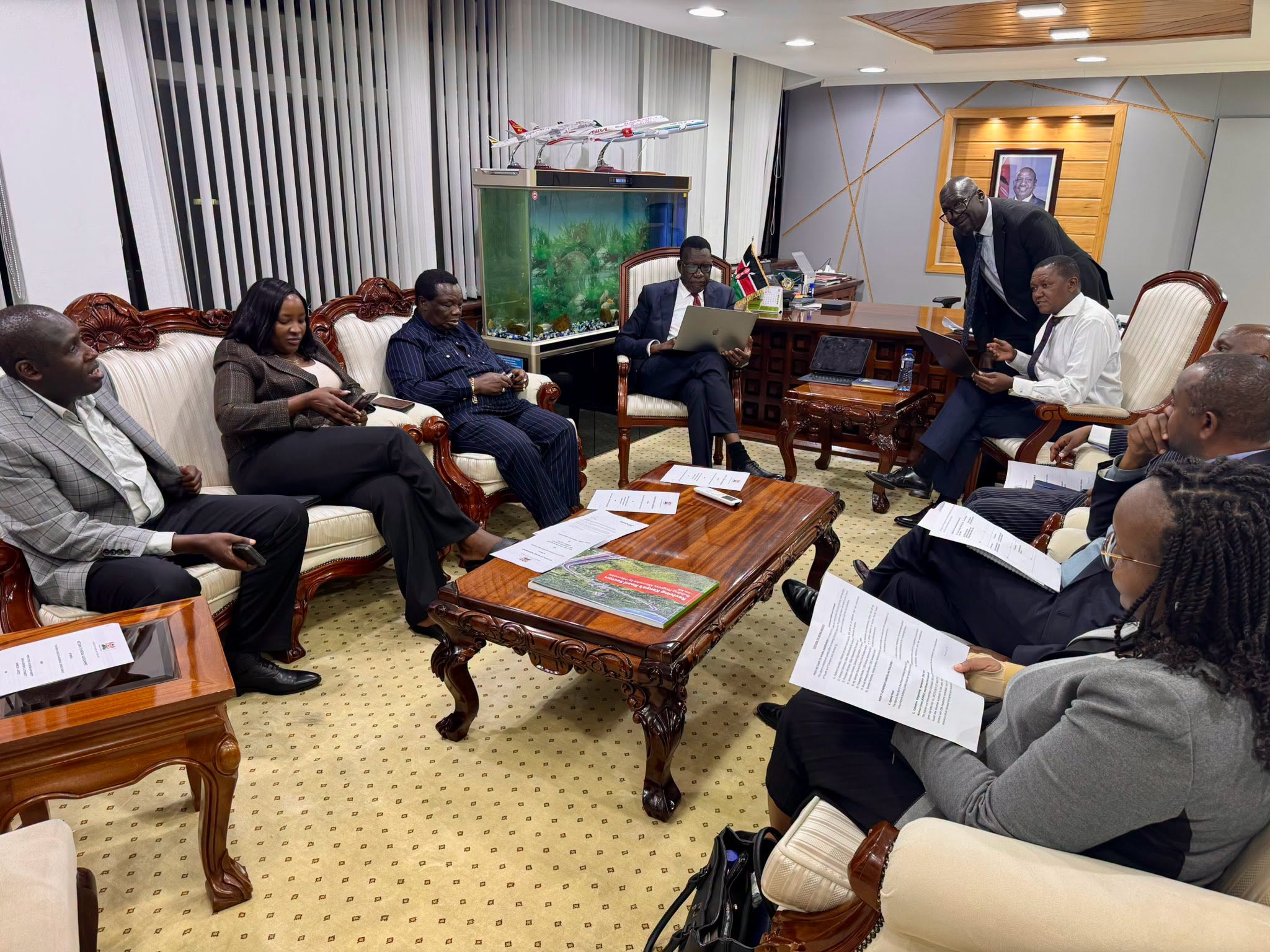
A marathon round of negotiations lasting through the night finally ended Kenya's aviation workers' strike, paving the way for the restoration of flights after two days of disruption that left passengers stranded and caused cancellations and delays across the region.
The breakthrough came at about 5.30am on Tuesday after government officials, union leaders and aviation executives spent hours negotiating a return-to-work agreement.
The deal involved the Kenya Aviation Workers Union (KAWU), Kenya Civil Aviation Authority (KCAA), Kenya Airports Authority (KAA) and Jambojet.
Transport Cabinet Secretary Davis Chirchir led the negotiations alongside Labour Cabinet Secretary Alfred Mutua, senior government officials and Central Organisation of Trade Unions (COTU) Secretary General Francis Atwoli.

KAWU subsequently called off the industrial action and directed aviation workers to immediately begin restoring normal operations.
But while the strike is over, several of the disputes that triggered it remain unresolved.
What workers got from the deal
One of the key agreements involves money owed to the union.
Agency fees collected by the Kenya Airports Authority and held on behalf of KAWU are to be released to the union immediately.
Another major dispute concerned the Collective Bargaining Agreement between KAWU and the Kenya Civil Aviation Authority.
The Salaries and Remuneration Commission withdrew earlier guidance issued in July and provided new parameters under which negotiations can proceed.
KAWU has expressed reservations about aspects of the new SRC guidelines but agreed to return to negotiations.
KCAA management, meanwhile, committed to honouring and implementing the eventual outcome of the CBA negotiations.
The dispute has been particularly significant because some collective bargaining issues in the aviation sector have remained unresolved for years.
Chirchir said the agreement established mechanisms for addressing three CBAs that had been suspended since 2015.
Workers protected from victimisation
The union also secured a commitment protecting workers who participated in the industrial action.
Under the return-to-work agreement, employees should not be victimised, intimidated, discriminated against or subjected to disciplinary action solely because they participated in the strike.
The protection was an important issue for union leaders, who had previously complained of alleged victimisation of workers.
Atwoli said sustainable industrial peace in the aviation sector must be built around both uninterrupted services and respect for workers' rights.
Jambojet dispute remains in court
Not every issue was resolved at the negotiating table.
The dispute over recognition of KAWU by Jambojet remains before the courts.
The two sides agreed to allow the judicial process to continue and committed to abide by the eventual court decision.
The government also undertook to address grievances concerning the management of the Kenya Airports Authority.
Other outstanding issues raised in the union's July strike notice are expected to undergo arbitration under the leadership of the Principal Secretary for Aviation and Aerospace Development within three weeks.
Ruto intervention over KAA boss
One of the most contentious issues during the negotiations reportedly involved demands concerning KAA Managing Director Moses Wekesa.
According to Nation, the matter became sufficiently difficult that President William Ruto had to intervene as negotiators sought a compromise.
The government ultimately undertook to handle issues touching on KAA's top management rather than making them a condition for immediately ending the industrial action.
That compromise helped clear one of the major obstacles to the return-to-work agreement.
Atwoli's 3.30am rhumba break
The talks were not without lighter moments.
Mutua revealed that at about 3.30am, with negotiations still dragging on, Atwoli entertained the exhausted participants with a rhumba dance.
“At 3.30am, Atwoli was entertaining us with a Rhumba dance, a real maestro,” Mutua said.
Negotiations nevertheless continued for another two hours before the breakthrough was reached at approximately 5.30am.
Mutua apologised to passengers affected by the disruption while acknowledging that the workers had legitimate grievances that needed to be addressed.
Strike disrupted regional aviation
The consequences had already spread beyond Kenya.
The industrial action, driven largely by air traffic controllers, caused delays and cancellations at Jomo Kenyatta International Airport and affected aviation connections across East Africa.
Flights involving Rwanda, Burundi, Tanzania, Uganda, Somalia and Mauritius were among those disrupted.
Passengers at JKIA reported spending hours waiting for information as airlines cancelled or rescheduled services.
The disruption demonstrated the strategic importance of Nairobi as an aviation hub and how industrial action at JKIA can quickly affect regional air connectivity.
KQ works through flight backlog
Calling off the strike did not immediately return operations to normal.
Kenya Airways said its teams had to work through a backlog of affected flights following the resumption of air traffic control services.
The airline expected normal operations to resume by Wednesday, September 2.
KQ also introduced concessions for passengers directly affected by the disruption.
Eligible passengers can change their travel dates without change or no-show penalties, while passengers with unused tickets can seek refunds without the normal refund penalties.
The airline has given affected passengers until September 20 to make qualifying changes or submit refund requests.
A deal, but not the end of the dispute
The return-to-work agreement has reopened Kenya's skies, but it has not eliminated the underlying labour tensions.
Collective bargaining negotiations still have to be completed, the Jambojet recognition dispute remains before the courts and grievances involving KAA management must still be addressed.
That makes the coming weeks critical.
The immediate crisis has been resolved through dialogue.
The bigger test is whether the agreements reached during the marathon negotiations are implemented before unresolved grievances trigger another disruption at one of East Africa's most important aviation hubs.
You may also like
Category: Business
Related Video: Dolly Parton’s Family Announces Her Passing in Emotional Tribute
Related Explainer: EXPLAINER: Why Kenya’s aviation workers are striking — and what travellers need to know
 Facebook
 Twitter / X
 WhatsApp
 LinkedIn
 Telegram
 Reddit