
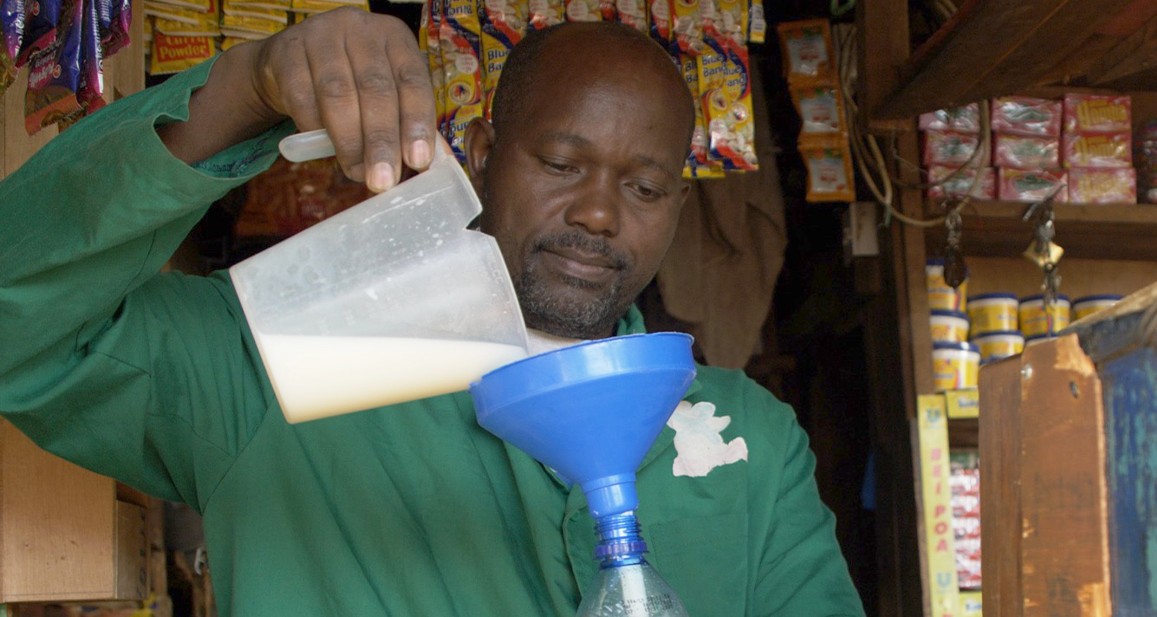
NAIROBI, Kenya — A milk shortage is squeezing Kenyan households, with empty supermarket shelves, purchase limits and rising prices becoming increasingly common in Nairobi and other parts of the country.
But behind the empty shelves is a more complicated story.
While consumers are struggling to find their preferred brands, some dairy farmers say they still have milk and are receiving low farm-gate prices, raising questions about whether Kenya's latest dairy crisis is purely a production shortage or also a failure in collection, processing and distribution.
The Kenya Dairy Board (KDB) has now acknowledged "temporary supply constraints" in parts of the country, attributing much of the disruption to seasonal production conditions.
Formal milk deliveries to processors declined by 3.7 per cent, from 84.4 million litres in June to 81.3 million litres in July 2026, according to KDB.
The Board says preliminary indications for August point to a further decline.
The impact is already visible at the checkout.
Some Nairobi retailers have reported price increases of between Sh3 and Sh5 for a 500ml packet, while other market checks have found sharper increases depending on brand and outlet.
At some stores, a 500ml packet has reportedly reached Sh75 from around Sh60, representing an increase of up to 25 per cent at those particular outlets.
Other market checks found long-life milk retailing for approximately Sh54 to Sh65, while available fresh milk was selling at roughly Sh61 to Sh65. Fresh milk at one dairy outlet increased from Sh70 to Sh80 per litre.
Supermarkets begin rationing milk
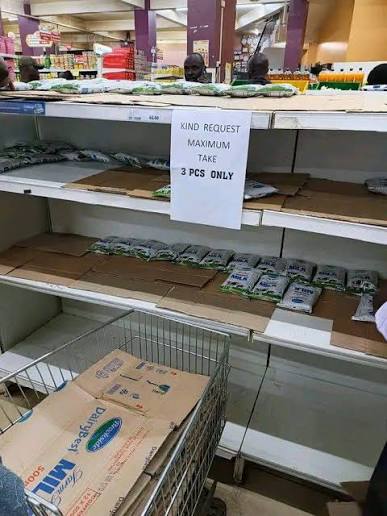
The shortage has become sufficiently severe for some retailers to restrict purchases.
A spot check reported by The Star found empty or thinly stocked shelves in Nairobi, with some outlets limiting customers to as little as one litre of milk from dispensers.
Some wholesalers were reportedly selling fewer than five packets to individual customers rather than allowing them to purchase entire cartons.
Other retailers have restricted shoppers to two boxes, while consumers have reported difficulty finding some popular brands and pack sizes.
KDB says its own market surveillance has confirmed low stocks, reduced availability of some brands and package sizes and delayed replenishment at some outlets.
Pasteurised fresh milk appears to have been affected more severely, while extended-shelf-life and UHT milk remains comparatively more available.
That makes this more than social-media speculation.
There is a measurable disruption in Kenya's formal milk supply chain.
So, where has Kenya's milk gone?
The most immediate explanation is the weather.
Dry and cold conditions in important dairy-producing regions have affected pasture and fodder availability, reducing milk production.
The National Drought Management Authority reported that 52.2 per cent of monitored arid and semi-arid counties recorded milk production below their long-term average in July.
The decline was associated with diminishing pasture and browse, deteriorating livestock conditions and animals travelling longer distances for water.
For individual dairy farmers, the effect can be dramatic.
Andrew Mbogo, a farmer in Narumoru, Nyeri County, told The Star that production from his cows had fallen from approximately seven to nine litres per cow to between four and five litres.
"Grass has dried and the little nappier grass I have is almost finished," he said.
He estimated his milk production had fallen by nearly half.
Feed prices are another part of the equation.
When natural pasture disappears, farmers become more dependent on commercial feeds. Higher production costs can then force farmers to reduce feed quantities, which further suppresses milk production.
The Consumers Federation of Kenya (COFEK) has consequently asked the Treasury to consider removing import duty and VAT from important dairy-feed ingredients such as yellow maize and soya.
Milk intake was already weakening
The warning signs did not begin in August.
KNBS data cited by COFEK shows formal milk intake falling from 88.89 million litres in May to 84.44 million litres in June, a month-on-month decline of approximately five per cent.
June's intake was also 6.4 per cent below the 90.24 million litres recorded in June 2025.
Between January and June 2026, formal milk intake totalled 513.32 million litres, slightly below the 516.34 million litres recorded over the equivalent period in 2025.
KDB's latest figures show the deterioration continuing into July, when processor deliveries dropped again to 81.3 million litres.
If August data confirms another decline, Kenya will have experienced at least three consecutive months of falling formal deliveries from May through August.
But farmers elsewhere say they have milk
This is where Kenya's milk crisis becomes more complicated.
A shortage on supermarket shelves does not necessarily mean there is no milk in the country.
In April, Kajiado dairy farmers were facing precisely the opposite problem — a milk glut.
Farmers said improved pasture following rains had increased production so sharply that local buyers could not absorb all the milk.
Some reported selling at around Sh30 per litre, while inadequate cooling and storage meant some milk was going to waste.
More recently, dairy farmers in parts of the North Rift have complained of milk going to waste because of inadequate markets and storage.
The Kenya Dairy Farmers Federation said some private processors had reduced intake, while farmers complained about low farm-gate prices and delayed payments.
That creates an uncomfortable contrast.
Consumers in Nairobi can struggle to find a packet of milk costing Sh60, Sh65 or even Sh75.
Yet a farmer elsewhere can struggle to sell a litre for Sh30.
One Facebook user commenting on the current shortage captured that contradiction bluntly: "Huku mkulima ananunuliwa na 35 na mnasema hakuna" — roughly, "Here the farmer is being paid Sh35 and you're saying there's none."
Another commenter said milk remained plentiful in Nyandarua.
These Facebook comments are anecdotal and cannot establish national supply levels, but they mirror concerns being raised independently by parts of the dairy industry.
A supply-chain problem?
Kieni Dairy Products CEO Solomon Maina argues that falling farm production cannot fully explain the shortages.
He points to processing costs, working capital and distribution challenges as additional factors.
Some processors may also choose to direct scarce raw milk towards higher-value products such as yoghurt, cheese and ice cream instead of ordinary pasteurised milk.
Delayed payments can create another distortion.
Farmers who must wait for processors or cooperatives to pay them may instead sell into the informal market, where cash payments can be immediate and prices higher.
Maina says informal buyers can offer farmers Sh70 to Sh80 per litre in some markets.
If enough milk shifts from formal processors into informal channels, supermarket supplies can fall even when milk continues circulating elsewhere in the economy.
This helps explain the paradox of farmers reporting milk while supermarket shelves remain empty.
Kenyans suspect something else
Online, however, many Kenyans are not convinced that weather explains everything.
The Facebook discussion reviewed for this story shows a mixture of humour, anger and suspicion.
"Maziwa haijapotea ni price ndiyo inakuja mpya," one commenter wrote — suggesting the milk had not disappeared but would return carrying a higher price.
Another predicted: "We are headed to @ksh.100 per 500ml."
Another described the situation as a possible "artificial shortage".
Those claims are public perceptions, not established facts. There is currently no evidence presented by KDB that processors or retailers have deliberately withheld milk to manufacture a shortage.
Other commenters simply confirmed what consumers are experiencing.
"Waaa haipatikani...ni mbayaa," one wrote — saying milk had become difficult to find.
Much of the discussion has also become distinctly Kenyan political humour.
"Cows are demonstrating they don't want to have IDs, they don't want to vote next year," one commenter joked.
Another quipped: "The cow was milked dry by the government!!!"
The comments cannot be treated as economic evidence, but they provide a snapshot of growing consumer frustration — particularly the suspicion that another essential household commodity is becoming more expensive.
COFEK gives government seven days
Consumer lobby COFEK has now demanded intervention.
It has called on the Ministry of Agriculture, National Treasury and Kenya Dairy Board to take coordinated action to restore supplies and stabilise prices.
COFEK wants the government to publish a milk-supply recovery plan, provide emergency fodder and feed support in affected dairy regions and consider tax relief for key animal-feed ingredients.
The organisation has given authorities seven days to explain measures being taken to address the problem.
Government says don't panic
The Kenya Dairy Board, however, maintains that the current disruption is temporary.
"Milk continues to be available in the market, despite temporary supply constraints being experienced in some parts of the country," KDB Managing Director Dr William Maritim said.
The regulator expects conditions to improve with the October-November-December rainfall season.
If the rains restore pasture and fodder, milk production should begin recovering.
KDB says government interventions also include distributing milk coolers to improve aggregation and preservation and supporting dairy herd improvement through subsidised sexed semen.
But rain alone may not solve the structural weaknesses exposed by the current shortage.
The bigger problem behind an empty shelf
Kenya's milk problem illustrates a longstanding weakness in agricultural markets.
Having enough food somewhere in the country is not the same as having it available where consumers need it.
Milk is highly perishable.
It has to be collected from thousands of farms, rapidly chilled, transported, tested, processed, packaged and distributed to retailers — all while maintaining a cold chain.
A failure at any point can create scarcity at the supermarket even when farmers elsewhere have unsold milk.
Kenya therefore faces two related questions.
The immediate one is how quickly pasture recovers and milk production rebounds.
The larger question is why a country capable of producing substantial quantities of milk can simultaneously have farmers complaining about low prices and wasted milk while consumers in its capital confront empty shelves and higher prices.
For households, that contradiction ultimately arrives as a simple problem at breakfast.
The milk is harder to find.
And when they do find it, they are increasingly paying more for it.
You may also like
Category: Business
Related Video: Gachagua’s explosive Ruto scorecard: Debt, taxes, State capture and a government ‘that has failed’
Related Explainer: Kenya G-to-G Oil Deal Explained: How It Works, Who Supplies the Fuel and Why It Is Controversial
 Facebook
 Twitter / X
 WhatsApp
 LinkedIn
 Telegram
 Reddit