
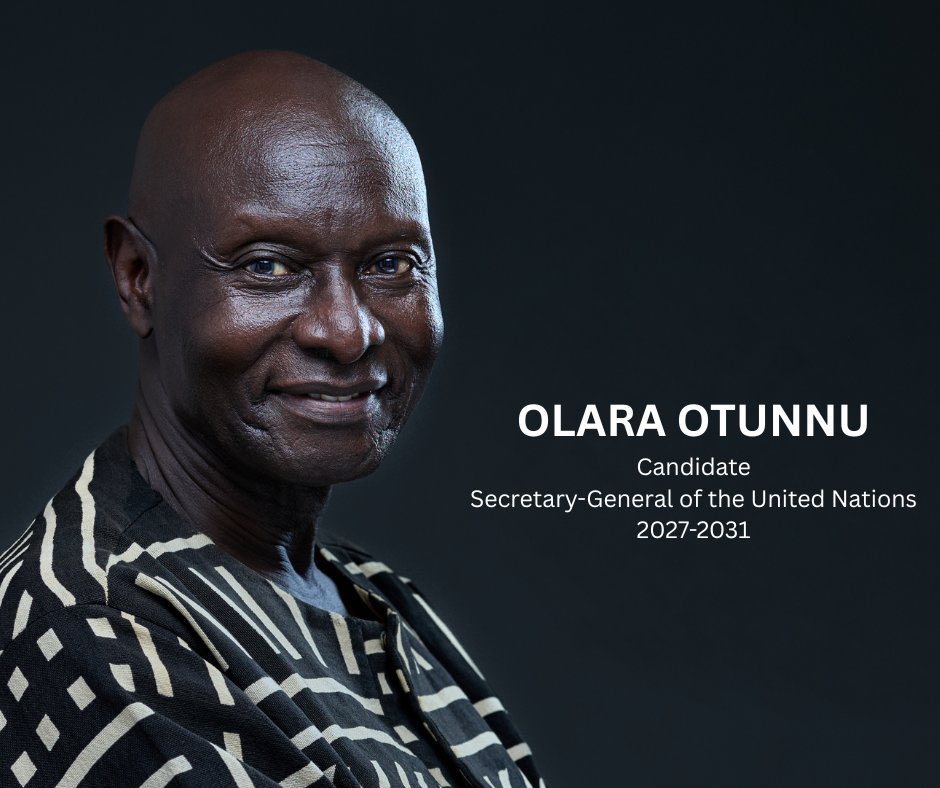
By August 2026, Olara Otunnu is no longer simply a veteran of the United Nations. He is Uganda's candidate to lead it.
For more than four decades, the Ugandan diplomat, lawyer and statesman has moved through the upper reaches of international diplomacy: from Uganda's mission at the United Nations to the presidency of the Security Council; from Uganda's Foreign Ministry to the top ranks of the UN Secretariat; and from the world's diplomatic chambers to the front lines of conflicts involving children.
Now, at 75, Otunnu is seeking the most powerful diplomatic post in the multilateral system: Secretary-General of the United Nations.
Uganda formally nominated him on **24 July 2026** to succeed António Guterres, whose second and final term ends on 31 December. The UN's official selection process lists Otunnu among the candidates and records his nomination by Uganda.
His candidacy is remarkable for another reason. Nearly 45 years ago, while serving as Uganda's representative at the UN, Otunnu helped devise the informal straw-poll method used to assess contenders for the secretary-generalship. Today, he is himself sitting on the other side of that process.
The symbolism is striking. The man who once helped refine the machinery for choosing a UN secretary-general now hopes to become the person chosen by it.
## A Ugandan shaped by upheaval
Olara A. Otunnu was born on **6 September 1950** in Mucwini, in northern Uganda, among the Acholi people.
He came of age during a period of profound political change. Uganda had gained independence in 1962, but by the time Otunnu reached adulthood the country was under the increasingly repressive rule of Idi Amin.
Otunnu studied at Mucwini, Mvara and Anaka primary schools before attending **Gulu High School and King's College Budo**. He went on to Makerere University, where he became president of the Students' Guild.
At Makerere, his student leadership developed into political activism. He became involved in opposition to Amin's government and co-founded the Uganda Freedom Union, an organisation that brought together Ugandans opposed to the regime.
The political pressure eventually forced him into exile in **1973**, when he escaped to Nairobi.
Exile became a turning point. In Kenya, Otunnu received an Overseas Scholarship to study at **Oxford University**. He later attended **Harvard Law School** as a Fulbright Scholar, earning the legal and international-affairs training that would underpin much of his subsequent career.
His early life therefore followed a trajectory that would become characteristic of his career: political conflict led to exile; exile led to international education; and international education led back to diplomacy and public service.
## From exile to Uganda's diplomatic service
Following the overthrow of Idi Amin in 1979, Otunnu returned to the political arena.
He served on Uganda's **National Consultative Council**, the interim legislative body established during the transition after Amin's fall. His involvement placed him among the generation attempting to rebuild a country emerging from years of dictatorship and political violence.
In **1980**, President Milton Obote appointed him Uganda's Permanent Representative to the United Nations.
It was an extraordinary diplomatic ascent for a man still only 29.
At the UN, Otunnu quickly became one of the more prominent African diplomats of his generation. He served as chairman of the African Group and held senior positions within the Non-Aligned Movement and the UN system.
In **1981**, he became President of the UN Security Council.
That year would eventually become one of the most important footnotes in his biography.
## The "Otunnu Formula"
The United Nations has never had a simple election for Secretary-General. The five permanent members of the Security Council—China, France, Russia, the United Kingdom and the United States—can veto a candidate, making consensus essential.
In 1981, as the Council considered candidates to replace Secretary-General Kurt Waldheim, Otunnu helped introduce an informal voting procedure to gauge support before governments committed themselves in a formal vote.
The method became known as the **"Otunnu Formula"** and developed into the straw-poll practice used in subsequent secretary-general selections.
It was an innovation born of diplomatic pragmatism: give governments a confidential way to indicate whom they could support, whom they could not, and where consensus might emerge.
The process helped the Security Council narrow the field in 1981, eventually leading to the selection of Peruvian diplomat **Javier Pérez de Cuéllar**.
Decades later, Otunnu would enter the same process as a candidate.
## A diplomat at the centre of the UN
Otunnu's responsibilities in the early 1980s extended far beyond the Security Council presidency.
He served as **Vice-President of the UN General Assembly**, chaired the **UN Commission on Human Rights**, and held senior responsibilities involving the Non-Aligned Movement and global negotiations. His period as Uganda's UN ambassador, from 1980 to 1985, established him as an experienced multilateral diplomat at a remarkably young age.
In **1985**, he returned home to serve as Uganda's **Minister of Foreign Affairs**, a position he held until 1986.
He played a prominent role in the Uganda peace talks that culminated in the **Nairobi Agreement of December 1985**, an episode that added conflict diplomacy and negotiation to an already expanding international résumé.
His government service was brief, but the peace negotiations were significant. They demonstrated that Otunnu's interest in diplomacy was not confined to the UN headquarters in New York; he was also prepared to apply negotiation to Uganda's own political crisis.
## Building a peace institution
After leaving government, Otunnu returned to international policy work.
In **1990**, he became President of the **International Peace Academy**, later renamed the International Peace Institute. He remained in that position until 1998.
His leadership expanded the organisation's profile and operations and deepened his involvement in international peace and security issues at a time when the end of the Cold War was reshaping the global order.
Then came the assignment that would define his international legacy.
## The children of war
On **19 August 1997**, UN Secretary-General Kofi Annan appointed Olara Otunnu as his Special Representative for Children and Armed Conflict, initially for a three-year period.
He took office on **1 September 1997** and became the first person to hold the position.
From 1997 to 2005, Otunnu served as **UN Under-Secretary-General and Special Representative for Children and Armed Conflict**.
The mandate was deceptively simple: put children affected by war at the centre of international attention.
But Otunnu sought to do much more than issue appeals on behalf of vulnerable children.
He set out to change the international system itself.
His role combined advocacy, diplomacy, field missions, political pressure and institution-building. He travelled to countries experiencing conflict or recovering from it, meeting governments, armed groups, UN officials and communities affected by war.
He argued that children should not be treated as an incidental humanitarian consequence of conflict. Their protection, he insisted, belonged within the core responsibilities of international peace and security.
That argument gradually became institutional reality.
## Changing the rules of war
During Otunnu's tenure, child protection moved from the margins of international diplomacy toward the centre of the UN's peace-and-security agenda.
His work contributed to a series of major innovations.
Among them were the development of a comprehensive body of international **protection norms and standards** for children affected by armed conflict; the incorporation of **child-specific war crimes into the Rome Statute** of the International Criminal Court; the development of **Child Protection Adviser** positions; and the practice of publicly identifying parties to armed conflict that recruit and use children in the annexes to the Secretary-General's reports.
His office also advanced the international **monitoring and reporting mechanism** for grave violations against children and promoted what became known as the **"Era of Application"**—the effort to move from declarations and standards toward actual compliance on the ground.
These were not merely technical reforms.
They changed the vocabulary of international accountability.
The recruitment and use of children in armed conflict could increasingly be documented, attributed and publicly named. Governments and armed groups could be subjected to international pressure. Child protection could be incorporated into peace operations and political negotiations.
In effect, Otunnu helped turn the plight of children from a humanitarian concern into an international peace-and-security issue.
## The architecture behind Resolution 1612
Perhaps the most consequential element of Otunnu's legacy was the compliance regime that culminated in **UN Security Council Resolution 1612**, adopted in July 2005.
Otunnu was a principal architect and advocate of the regime.
Resolution 1612 formally established a comprehensive international monitoring and reporting mechanism to document grave violations against children in situations of armed conflict. It also created a process through which offending parties could be identified and publicly listed, creating pressure for accountability and compliance with international standards.
The significance of the system was its practical ambition.
It was designed not simply to record suffering but to create a chain of accountability: document violations, identify perpetrators, bring international pressure to bear and seek concrete changes in behaviour.
The mechanism became one of the enduring pillars of the UN's work on children and armed conflict.
It is difficult to understand today's UN child-protection architecture without understanding the role Otunnu played in building its foundations.
## A global advocate recognised
Otunnu's work brought international recognition.
He received the **Distinguished Service Award of the United Nations Association of the United States of America in 2001**, the **German Africa Prize in 2002**, and the **Sydney Peace Prize in 2005**.
In 2006, he received the **Global Award for Outstanding Contribution to Human Rights** in India.
The following year, Harvard Law School honoured him with the **Harvard Law School Association Award**.
These honours reflected a career that had by then crossed several distinct fields—law, diplomacy, human rights, peacebuilding and the protection of children.
## Returning to Ugandan politics
After leaving the UN in 2005, Otunnu eventually returned to Ugandan party politics.
In **2010**, he became president of the **Uganda People's Congress (UPC)**, one of Uganda's historic political parties.
He was subsequently selected as the UPC's presidential candidate for the **2011 general election**.
Otunnu's campaign was unsuccessful. He received **125,059 votes, or 1.58 percent of the valid presidential vote**, according to the official election results.
The episode demonstrated a different side of his career. The veteran international diplomat was willing to return to the political contest at home, even after spending much of his professional life abroad.
Yet electoral politics did not erase his international reputation.
## The return to the UN stage
In July 2026, Uganda put Otunnu forward for the position that had been indirectly connected to his career since 1981: **Secretary-General of the United Nations**.
Uganda's formal nomination was submitted on **24 July 2026**. The UN now lists Otunnu among the candidates seeking to succeed António Guterres.
The timing is significant.
Guterres, who has served two five-year terms, is due to leave office at the end of 2026. The next secretary-general will inherit a UN system facing wars, geopolitical rivalry, pressure for institutional reform, questions over the future of multilateralism and a growing debate over the organisation's ability to respond effectively to emerging technologies and global crises.
Otunnu has made **UN reform** a central element of his campaign.
During his August 2026 dialogue with UN member states and civil society, he argued for continued reform and what he described as a need for **moral renewal** within the organisation. He warned against complacency and "business as usual" in a bureaucracy he believes must become more effective and responsive.
He has also called for stronger conflict resolution, institutional reform, climate action linked to economic development and international mechanisms capable of addressing challenges such as artificial intelligence.
His message is consistent with the trajectory of his career: an emphasis on prevention, accountability, diplomacy and institutions that can translate international commitments into practical results.
## The dark horse in a crowded field
Otunnu's path to the UN's top job is far from guaranteed.
He entered the race relatively late and is competing against a field that, as of August 2026, includes candidates from Argentina, Chile, Costa Rica, Ecuador, Guyana and Senegal, alongside Uganda. Ecuador's Ivonne Baki became the eighth candidate in August.
There are also powerful political considerations.
An informal tradition of regional rotation has led many observers to argue that Latin America and the Caribbean have a strong claim to the next secretary-generalship. There is also significant international attention on the possibility of electing the UN's first woman secretary-general.
The selection ultimately depends on the Security Council. A candidate must secure the Council's recommendation without being blocked by one of its five permanent members before the General Assembly appoints the secretary-general.
That makes the process as much about consensus and acceptability as about credentials.
And Otunnu has an unusually deep set of credentials.
He has been a UN ambassador, Security Council president, General Assembly vice-president, human rights leader, foreign minister, peace-institute president and UN Under-Secretary-General.
He has negotiated at the highest levels and worked directly in conflict zones.
And he understands the internal machinery of the organisation from personal experience.
## A second straw poll changes the picture
The first Security Council straw poll in July gave Costa Rica's Rebeca Grynspan the strongest showing.
But the second informal poll, held on **21 August 2026**, produced a notable development for Otunnu.
According to reporting on the confidential results, he increased his "encourage" votes from **two to five**, while receiving five "discourage" votes and five "no opinion" ballots. That made him the candidate with the sharpest increase in support between the first and second polls.
Guyana's Carolyn Rodrigues-Birkett emerged with the highest number of "encourage" votes in the second poll, with eight, followed by Grynspan and Argentina's Rafael Grossi with seven each. No candidate had yet secured the nine affirmative votes needed to establish a clear consensus.
The polls are non-binding and do not determine the eventual winner.
But they matter because the secretary-generalship is ultimately a search for a candidate acceptable to the five permanent members as well as the wider Council.
For Otunnu, the second poll demonstrated something important: his candidacy had not disappeared after entering the race late.
It had gained ground.
## The case for Otunnu
The strongest argument for Otunnu is not simply that he is Ugandan, African or a veteran diplomat.
It is that he has spent much of his life inside the institutions he now seeks to lead.
He knows what it means to represent a developing country at the United Nations. He knows the Security Council from the chair. He has experienced the political pressures of government. He has negotiated peace agreements. He has managed an international policy institution. And he has spent eight years trying to turn international declarations into mechanisms capable of protecting children in real wars.
That combination is rare.
His supporters can also point to a remarkable historical symmetry.
In 1981, Otunnu helped create an informal method for narrowing the field of candidates for UN secretary-general.
In 2026, that same method is being used to assess him.
## The case against him
The obstacles are equally real.
His candidacy came late. The regional dynamics of the selection favour other parts of the world. Several candidates have stronger early support. And the five permanent members of the Security Council ultimately have the ability to block any candidate.
There is also the question of political momentum.
The UN secretary-general is not chosen simply by identifying the most experienced diplomat. The successful candidate must emerge as a compromise acceptable to powerful governments with competing geopolitical interests.
That is where Otunnu's diplomatic record could become either his greatest asset or insufficient by itself.
## More than a candidacy
Whatever happens in the 2026 race, Otunnu's place in international diplomacy was established long before Uganda nominated him for the UN's top job.
His career began amid the political turmoil of Uganda in the 1970s. It took him into exile, to Oxford and Harvard, and then back into Ugandan public life. It carried him to New York as Uganda's UN ambassador, to the presidency of the Security Council, to Uganda's Foreign Ministry and to the leadership of an international peace institute.
Then came the role that defined his global legacy: eight years as the UN's first Special Representative for Children and Armed Conflict.
There, he helped build institutions that continue to shape how the international community responds to children caught in war.
His life has consequently been more than a succession of titles.
It has been a career spent moving between **Uganda and the world, diplomacy and conflict, politics and international law, advocacy and institution-building**.
Now, at 75, the Ugandan statesman is asking the United Nations to entrust him with its highest office.
The question is no longer whether Olara Otunnu has spent enough time at the United Nations.
He has.
The question facing member states is whether the diplomat who once helped design the system for choosing the UN's secretary-general can now persuade the system to choose him.
---
## Olara Otunnu: Career at a Glance
**1950 — Birth**
Born on 6 September in Mucwini, northern Uganda, among the Acholi people.
**1960s–1970s — Education**
Educated at schools including Gulu High School and King's College Budo; later studied at Makerere University, where he became president of the Students' Guild.
**1973 — Exile**
Leaves Uganda amid pressure from the Idi Amin regime and goes into exile in Nairobi.
**1970s — Oxford and Harvard**
Studies at Oxford University as an Overseas Scholar and later at Harvard Law School as a Fulbright Scholar.
**1979 — National Consultative Council**
Returns to Uganda after the fall of Idi Amin and serves on the National Consultative Council.
**1980–1985 — Uganda's UN Ambassador**
Serves as Uganda's Permanent Representative to the United Nations.
**1981 — President of the Security Council**
Presides over the UN Security Council and helps develop the informal straw-poll method later associated with the "Otunnu Formula."
**1982–1983 — UN General Assembly leadership**
Serves as Vice-President of the General Assembly and holds senior roles connected with global negotiations and the Non-Aligned Movement.
**1984 — Human rights leadership**
Chairs the UN Commission on Human Rights.
**1985–1986 — Foreign Minister of Uganda**
Returns home as Minister of Foreign Affairs and plays a prominent role in peace negotiations culminating in the Nairobi Agreement.
**1990–1998 — International Peace Academy**
Serves as President of the International Peace Academy, later renamed the International Peace Institute.
**19 August 1997 — UN appointment**
Kofi Annan appoints Otunnu as his first Special Representative for Children and Armed Conflict.
**1997–2005 — UN Under-Secretary-General**
Leads the UN's international campaign to protect children affected by armed conflict.
**2001 — Distinguished Service Award**
Receives the Distinguished Service Award from the United Nations Association of the United States of America.
**2002 — German Africa Prize**
Receives the German Africa Prize.
**2005 — Sydney Peace Prize**
Receives the Sydney Peace Prize for his work on children and armed conflict.
**2005 — Resolution 1612**
The Security Council adopts Resolution 1612, establishing the monitoring and reporting mechanism on grave violations against children in armed conflict.
**2006 — Human Rights Award**
Receives the Global Award for Outstanding Contribution to Human Rights in India.
**2007 — Harvard honour**
Receives the Harvard Law School Association Award.
**2010 — Uganda People's Congress**
Becomes president of the Uganda People's Congress.
**2011 — Presidential candidate**
Runs for President of Uganda as the UPC candidate, receiving 1.58 percent of the vote.
**24 July 2026 — UN Secretary-General candidate**
Uganda formally nominates Otunnu for Secretary-General of the United Nations.
**19 August 2026 — Candidate dialogue**
Presents his vision for the UN to member states and civil society, stressing reform and moral renewal.
**21 August 2026 — Second Security Council straw poll**
Otunnu records five "encourage" votes, up from two in the first poll, in a field of eight candidates.
**January 2027 — Potential new chapter**
The successful candidate is expected to begin the next UN Secretary-General's term on 1 January 2027. As of 23 August 2026, Otunnu remains a candidate, not the office-holder.
### The larger story
Olara Otunnu's candidacy is ultimately about more than one Ugandan seeking one international office.
It is the latest chapter in a life that has repeatedly placed a Ugandan at the intersection of national struggle and global diplomacy.
If he succeeds, Otunnu would return to the organisation he first entered as Uganda's representative in 1980—this time not as an ambassador representing one country, but as Secretary-General responsible for representing the interests of the international community as a whole.
If he does not, his record will still stand: a Ugandan diplomat who helped shape how the United Nations chooses its leaders, and who helped build one of the world's most important systems for protecting children in war.
For now, however, the possibility remains open.
**Olara Otunnu could become the first Ugandan to serve as Secretary-General of the United Nations.**
Related Stories
- Zambia’s Hakainde Hichilema Wins Second Presidential Term
- Zambia halts vote count after ballot theft claims
- UN Warns Museveni as Concern Mounts Over Crackdown on Opposition and Civil Society
Category: International
 Facebook
 Twitter / X
 WhatsApp
 LinkedIn
 Telegram
 Reddit