
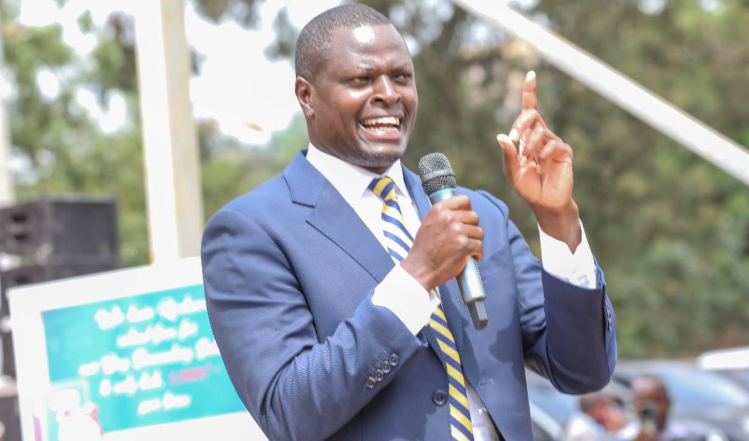
Kiharu Member of Parliament Ndindi Nyoro has declared his intention to run for President in the 2027 General Election, putting himself directly into a presidential contest that is already reshaping Kenya's political alliances.
Nyoro's declaration marks a significant escalation in his political journey. For years, the youthful legislator has been discussed as a potential player in Kenya's post-Ruto succession politics. His decision to openly pursue the presidency now moves him from the realm of political speculation into the arena of declared ambition.
The announcement comes at a particularly important moment. Nyoro has recently separated himself from President William Ruto's United Democratic Alliance (UDA), ending an association that helped propel him to national prominence. Earlier reports indicated that Nyoro had said he and his supporters had already moved away from UDA and that he was consulting before announcing his next political direction.
The People's Party of Kenya connection
Nyoro's emergence around the People's Party of Kenya (PPK) adds another dimension to the announcement.
PPK is an officially registered Kenyan political party listed by the Office of the Registrar of Political Parties (ORPP). The ORPP lists the party under the acronym PPK, with the slogan "Usawa Haki Uhuru."
The party's own official website describes PPK as a movement committed to building a just society founded on equity, justice and liberty. It says its mission is to mobilise Kenyans towards a new political order free from tribalism, hatred and nepotism.
Those themes could provide an interesting political platform for Nyoro, whose public profile has increasingly centred on economic management, accountability, entrepreneurship and the cost of living.
However, PPK's current leadership structure should not be confused with Nyoro's presidential declaration. The party's website currently lists Mark Odhiambo as chairperson and John Kihiu Chere as secretary-general, among other officials.
From Ruto ally to presidential contender
Nyoro's declaration represents a remarkable shift from his earlier political position.
He was one of the most visible supporters of William Ruto during the political battles that preceded the 2022 election. After Kenya Kwanza came to power, Nyoro became chairperson of the powerful National Assembly Budget and Appropriations Committee, placing him at the heart of national economic decision-making.
His relationship with the administration subsequently became more complicated.
Parliamentary records from 2026 show Nyoro increasingly questioning government spending, borrowing and fiscal policy. In a June 2026 parliamentary debate, he criticised what he described as excessive government expenditure and argued that the government needed to cut unnecessary spending rather than continually ask ordinary Kenyans to tighten their belts.
His May 2026 parliamentary contributions also showed him pushing for a more sophisticated Kenyan economy, greater value addition, increased foreign investment and stronger use of technology to improve exports.
This economic-policy profile could become central to his presidential campaign.
Why Nyoro's candidacy matters
Nyoro is not entering the race as an unknown political figure.
He has served as Kiharu MP since 2017 and has developed a strong political base in Murang'a and the wider Mt Kenya region. His age also gives him a generational advantage in a political environment increasingly dominated by conversations about leadership transition.
The Star reported in July that Nyoro was among younger politicians already being positioned in discussions about Kenya's post-Ruto political order.
His political possibilities have also attracted attention beyond his immediate supporters. In 2025, Embakasi East MP Babu Owino publicly floated the possibility of a joint 2027 presidential ticket involving himself and Nyoro, demonstrating that Nyoro's name had already entered national-level coalition calculations.
Now, by declaring his own presidential ambition, Nyoro potentially changes the equation.
Can PPK become a national vehicle?
The bigger question is whether the People's Party of Kenya can provide Nyoro with the machinery required for a serious presidential campaign.
Kenya's presidential elections are expensive, highly organisational and heavily dependent on nationwide networks. A presidential candidate must go beyond a strong regional base and demonstrate an ability to build support across the country's ethnic, regional and political divisions.
That is where PPK's stated philosophy could become important.
The party says it wants to build a political order without tribalism and nepotism, while promoting equity, human rights and freedom of expression. Its current manifesto also highlights healthcare, agriculture and food security, land and housing, sports and culture, environmental management and foreign policy.
For Nyoro, the challenge will be converting those principles into a compelling national political programme—and convincing voters that his candidacy represents more than a realignment within the Mt Kenya political establishment.
A crowded 2027 field
Nyoro's entry comes as Kenya's 2027 political landscape becomes increasingly fluid.
President Ruto is expected to seek a second term, while opposition and independent political formations are considering competing strategies. Other younger politicians are also positioning themselves for influential roles.
The result could be an election in which traditional alliances are less predictable than in previous cycles.
Nyoro's own political journey illustrates this transformation. He moved from being a prominent Ruto ally to distancing himself from UDA and is now presenting himself as a presidential contender.
That trajectory could appeal to voters seeking generational change—but it also exposes him to scrutiny over his previous association with the current administration.
The economic question
Perhaps Nyoro's strongest potential selling point is his economics background.
His public interventions have consistently focused on government budgets, public debt, taxation, investment, entrepreneurship and economic growth. In Parliament, he has argued that Kenya needs to move beyond dependence on primary commodities and add technology and value to what it exports.
That gives him an opportunity to build a presidential campaign around the economy rather than purely around identity politics.
But it also creates a high bar.
Kenyans will ultimately want to know what a Nyoro presidency would do differently from the governments he has previously supported. Questions about taxation, debt, government expenditure, jobs, healthcare, education and the cost of living are likely to dominate any serious presidential campaign.
From succession speculation to declared ambition
For several years, Nyoro's name has featured in conversations about Kenya's next generation of national leaders.
That speculation has now acquired a different meaning.
By declaring his intention to seek the presidency, Nyoro is effectively telling the political establishment that he does not necessarily see his future merely as a running mate, Cabinet figure or parliamentary power broker.
He wants the top job.
The immediate test will be whether he can transform his considerable profile in Mt Kenya into a genuinely national movement.
And that is where the People's Party of Kenya could become critical.
If Nyoro succeeds in combining PPK's message of "Usawa, Haki na Uhuru" with his economic credentials and a broad national coalition, his candidacy could become one of the more consequential new developments in the 2027 race.
If he fails to build that national coalition, his presidential bid could instead become another example of Kenya's long list of ambitious politicians whose influence remained largely regional.
Either way, Ndindi Nyoro's declaration has moved the 2027 succession debate into a new phase.
The question is no longer whether Nyoro has presidential ambitions. The question is how far he can take them.
Livenow Africa will continue tracking Ndindi Nyoro's presidential campaign, PPK's political strategy and the evolving 2027 alliances.
Sources: Office of the Registrar of Political Parties; People's Party of Kenya; National Assembly/Mzalendo parliamentary records; Citizen Digital; The Star; Daily Trends.
You may also like
Category: Politics · Related Topic: 2027 Elections
Related Video: Human Ladder Reaches Dangerous Heights as Climbers Keep Going
Related Explainer: Kiharu Technical College September Intake 2026: Courses, Skills and New Opportunities
 Facebook
 Twitter / X
 WhatsApp
 LinkedIn
 Telegram
 Reddit