
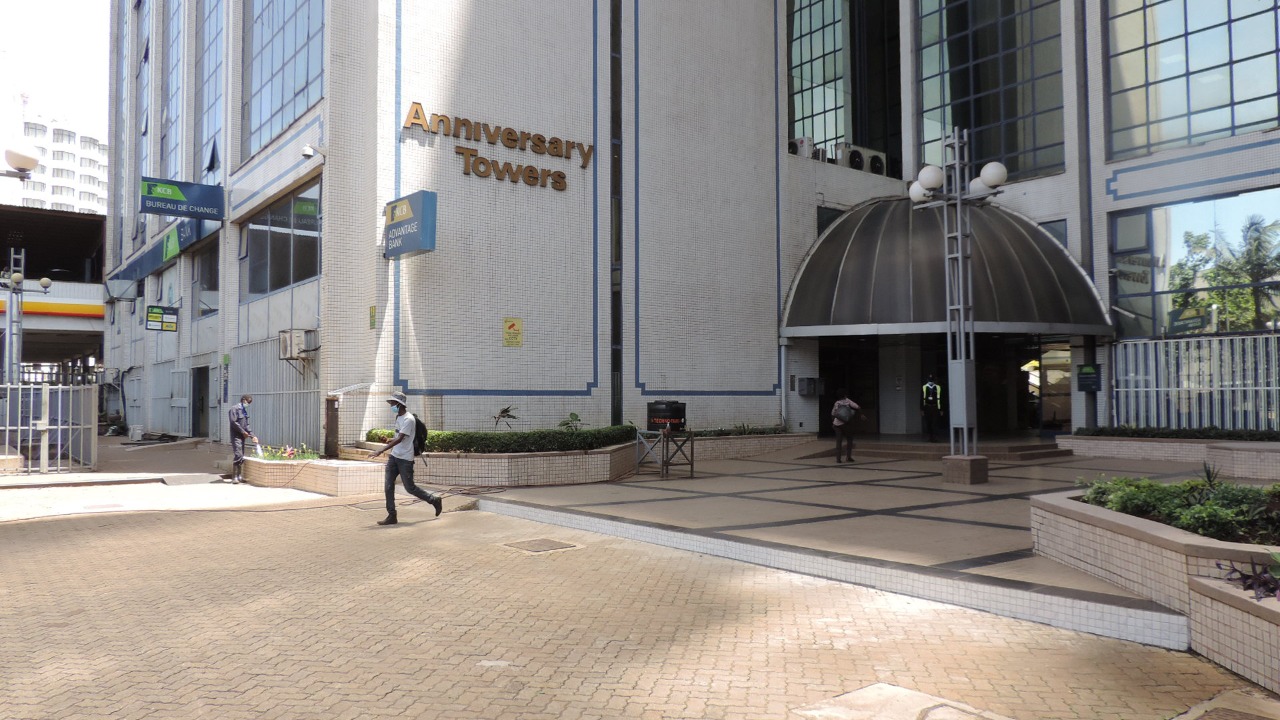
A Nairobi university professor is struggling to piece together three missing days of his life after what he believes was a drug-facilitated robbery that began with an apparently harmless request for directions near Anniversary Towers in the city centre.
The professor, whose identity is being withheld for his privacy and security, says he was in Nairobi's CBD when an elderly man approached him and asked for directions.
It is the last encounter he clearly remembers.
What happened afterwards remains largely a blank.

According to his account, the professor apparently lost normal awareness of his surroundings and later disappeared. He was eventually found three days later in a forest, far from where the encounter had begun.
His recently acquired vehicle was gone.
So were his mobile phones, cash and other valuables.
By the time he was able to establish what had happened to his finances, money had also been withdrawn from his accounts.
Even now, he is struggling to reconstruct how he moved from central Nairobi to the place where he was eventually found, who he was with during those missing days and how the people who robbed him gained sufficient access to his financial information.
His experience has renewed concern about criminals allegedly using incapacitating substances to rob victims in Nairobi — incidents popularly associated with scopolamine, better known by the ominous street name “Devil's Breath.”
But the professor's case has not been independently confirmed through toxicology as scopolamine poisoning, and that distinction is important.
What is clear is that his account bears similarities to other reports of victims becoming confused or losing memory before discovering that their phones, money and other possessions had disappeared.
Similar warnings have surfaced in Nairobi
The concern is not entirely new.
In September 2025, Nairobi authorities announced a joint crackdown with the National Police Service following public complaints about muggings and suspected drugging incidents in the CBD.
Residents had posted accounts alleging that some victims became disoriented before being robbed. Nairobi County official Geoffrey Mosiria said authorities were responding to complaints about changing tactics used by criminals operating in the city centre.
Another case involved law student Adrian Oluoch, who told The Standard in August 2025 that he believed he had been drugged at the Super Metro terminus near Archives in Nairobi.
Oluoch said he became disoriented during the encounter and was assisted by a conductor before the situation deteriorated further.
There have also been more conventional drug-facilitated robbery cases.
In June 2025, police investigated the case of Nairobi resident Simon Katumo, who said he was drugged after meeting two men during a night out along River Road.
He reportedly lost consciousness after drinking with the men and later discovered that his phone was missing and Sh290,000 had been taken from his M-Pesa and bank accounts.
Police subsequently arrested two suspects, who were charged and denied the allegations in court.
In another case reported in 2024, detectives arrested three people accused of drugging and robbing Nairobi revellers. One victim told investigators that he had been stupefied and robbed before money was withdrawn from his M-Pesa account.
Even a senior detective has previously testified about becoming a victim of suspected stupefying.
Senior DCI officer Paul Mumo Maingo told a Nairobi court that after a night out in Juja he became dizzy and mentally unstable, then discovered that his phones, wallet and watch were missing.
He later learnt that transactions totalling more than Sh1.15 million had been made from his bank account.
More recently, in September 2026, another Nairobi resident publicly alleged that a man operating around Karen approached victims pretending to need financial assistance before they became disoriented and were robbed. Other social-media users subsequently claimed similar encounters, although those allegations have not been established through publicly available toxicology results.
Taken together, the cases point to a real problem of drug-facilitated robbery.
What is considerably harder to establish is whether all — or even most — involve scopolamine.
What exactly is ‘Devil's Breath’?
Scopolamine is not a fictional drug.
It is a powerful anticholinergic compound that also has legitimate medical applications. In controlled doses, it is used to prevent motion sickness and nausea associated with surgery and anaesthesia. The US Food and Drug Administration, for example, approves scopolamine in transdermal patches for these purposes.
At toxic doses, however, the drug can have profound neurological effects.
Medical literature documents symptoms including confusion, disorientation, hallucinations, blurred vision, rapid heartbeat, urinary retention and severe memory impairment.
One of the characteristics that makes scopolamine particularly concerning in suspected criminal use is anterograde amnesia — difficulty forming memories of events occurring while intoxicated.
Medical literature has documented cases in which people exposed to scopolamine retained little or no memory of significant periods surrounding their intoxication.
A 2026 medical case report involving a 34-year-old woman confirmed scopolamine through advanced laboratory testing after she developed acute confusion, hallucinations, speech difficulties and other neurological symptoms.
Doctors noted that routine toxicology screening had initially failed to detect the substance.
That presents a particular challenge in criminal investigations.
A victim may not realise what has happened until hours later. By the time they reach a hospital, obtaining forensic proof of the exact substance involved can be difficult.
But beware the myths
The terrifying reputation surrounding “Devil's Breath” has also produced exaggerations.
Some Kenyan reports and social-media warnings claim criminals can simply touch someone, hand them contaminated paper or briefly blow powder towards them and almost immediately take control of their will.
Such claims should be treated cautiously.
Scopolamine does not literally remove a person's “free will” or provide a criminal with supernatural control over a victim.
What toxic doses can do is cause severe confusion, impaired judgment, sedation, delirium and memory loss. Those effects can make someone extremely vulnerable to manipulation and robbery.
The route and dose of exposure also matter.
Medical scopolamine can be absorbed through the skin, but the FDA-approved transdermal product uses a specially designed patch that continuously releases the medicine for as long as three days. That is very different from assuming that fleeting contact with a stranger automatically delivers an incapacitating dose.
In suspected criminal cases, victims may also have been exposed to other substances — or combinations of substances.
Kenyan investigations into drug-facilitated robberies have previously mentioned sedatives and other incapacitating drugs alongside scopolamine.
Without toxicological evidence, therefore, describing every unexplained drugging as a confirmed “Devil's Breath” attack risks turning a genuine crime problem into an urban legend.
NACADA has previously warned about scopolamine
Kenya's National Authority for the Campaign Against Alcohol and Drug Abuse has itself discussed criminal misuse of scopolamine.
In a 2024 public information article, NACADA said cases associated with suspected scopolamine exposure had previously been reported in Kenya, including incidents involving traders in Isiolo.
One victim was reported to have disclosed her M-Pesa PIN before losing more than Sh60,000.
NACADA describes confusion, hallucinations, drowsiness and blurred vision among the possible effects of high-dose exposure.
That combination helps explain why criminals would be interested in substances capable of impairing victims.
Modern robbery also offers criminals something that previous generations of thieves did not have: immediate access to a victim's digital financial life.
Stealing a phone can potentially expose M-Pesa, banking applications, email accounts and personal information.
If a victim can additionally be manipulated into revealing a PIN or unlocking a device, the loss can escalate from a stolen handset to the draining of bank and mobile-money accounts.
That pattern appears repeatedly in Kenyan drugging cases.
The professor's missing three days
For the Nairobi professor, the greatest loss may ultimately be the period he cannot remember.
A vehicle can potentially be traced.
SIM cards can be replaced.
Bank transactions can be investigated.
But three days missing from one's memory leave questions that are much harder to answer.
How did he leave Anniversary Towers?
Was he still driving his own vehicle?
Who was with him?
How were his phones and banking services accessed?
Where was he kept?
And how did he eventually end up in the forest where he was found?
Those questions should now be matters for investigators, supported where possible by CCTV footage, mobile-phone records, vehicle tracking information and banking transactions.
The area around Anniversary Towers and the wider Nairobi CBD contains extensive CCTV coverage. Financial transactions similarly leave electronic trails.
That evidence could be far more useful in establishing what happened than speculation about the particular substance involved.
What Nairobi residents should do
The emerging pattern does not mean people should panic whenever a stranger asks for directions.
But unexplained sudden confusion, extreme drowsiness, memory loss, blurred vision, hallucinations or abnormal behaviour after an encounter should be treated seriously.
A suspected victim should be moved to safety and taken for medical assessment as quickly as possible. Severe poisoning can cause dangerous complications, and rapid medical attention may also improve the possibility of obtaining useful toxicology samples.
Banks and mobile-money accounts should be blocked immediately where possible, and the incident reported to police.
People should also avoid accepting unknown drinks, food, medicines or substances from strangers and should be cautious about handing unlocked phones to unfamiliar people.
Most importantly, someone who suddenly appears confused should not automatically be dismissed as drunk.
They could be ill, poisoned or the target of a crime.
For Nairobi authorities, the professor's account presents a more fundamental challenge.
Whether the substance eventually proves to be scopolamine, another incapacitating drug or something else entirely, criminals who can allegedly take a person from the middle of Nairobi, strip them of their vehicle and digital finances and leave them kilometres away represent a serious public-security threat.
The frightening part of the professor's account is therefore not the nickname “Devil's Breath.”
It is that he remembers an elderly stranger asking for directions near Anniversary Towers — and almost nothing about the three days that followed.
You may also like
Category: News
Related Video: How a tweet cost Idris Mukhtar a job with CNN | Globe Traktion Ep# 11
 Facebook
 Twitter / X
 WhatsApp
 LinkedIn
 Telegram
 Reddit