
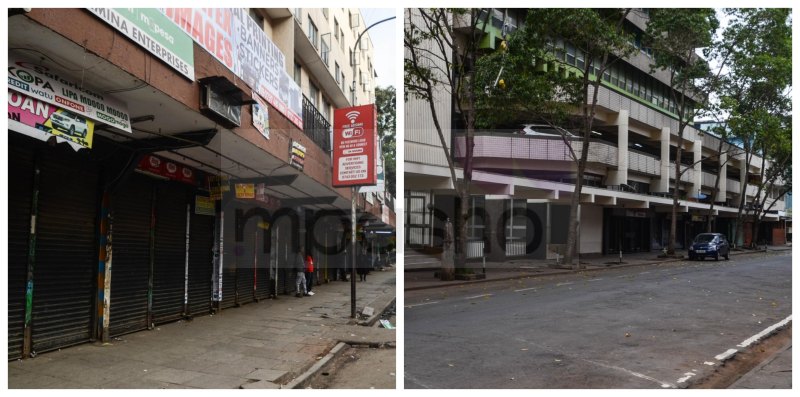
NAIROBI, Kenya — Parts of Nairobi’s Central Business District fell unusually quiet on Friday as traders shut their shops and took their protest to the Kenya Revenue Authority (KRA), angry over a new customs benchmark for consolidated imports.
Traders from markets including Kamukunji, Gikomba and Nyamakima marched towards Times Tower, KRA’s headquarters, to demand a reversal of the new minimum benchmark, which rose from Sh2.5 million to Sh3.2 million for a 40-foot container carrying general consolidated cargo.
The change represents an increase of Sh700,000, or 28 per cent, and took effect on August 20.
For small-scale importers who share containers to bring in merchandise, the dispute is not simply about a number on a customs document. Traders say the higher benchmark could eat into already narrow profit margins and eventually push up prices for consumers.
But KRA insists there is an important misunderstanding at the centre of the protests.
The authority says Sh3.2 million is a minimum reference point used under a simplified customs clearance arrangement, not a fixed tax bill imposed on every container.
In a clarification issued on Thursday, KRA said the actual customs value and tax payable depend on the nature, value and classification of the goods. Importers must still declare the true value of their merchandise.
Why traders are angry
The new benchmark affects consolidated cargo, a system widely used by small traders who combine goods belonging to several importers in one container.
The arrangement allows traders to share shipping and clearance costs, making it easier for smaller businesses to import goods without filling an entire container.
Traders opposing the new benchmark say increasing the minimum reference value could make the arrangement more expensive and leave them with less room to absorb other business costs.
The protests were expected to draw traders from several Nairobi markets, with some businesses closing in solidarity. Shops along parts of Moi Avenue, Kenyatta Avenue and Tom Mboya Street were reported closed on Friday morning.
The disruption, however, was not citywide.
Business activity in Eastleigh largely continued after the Eastleigh Business Community advised traders to remain open and stay away from street demonstrations while discussions with KRA continue.
Public transport also continued operating, meaning the protest did not bring Nairobi’s wider commercial activity to a standstill.
KRA: It is not a Sh3.2 million tax bill
KRA has moved to counter what it says is a misconception about the revised figure.
The authority says the benchmark is a risk-management reference used to simplify the clearance of certain consolidated cargo. It does not mean that Customs automatically treats every container as having goods worth Sh3.2 million or charges every importer taxes based on that figure.
Where traders believe the benchmark does not reflect the actual contents of their cargo, KRA says they can request physical verification so that Customs determines the applicable value and taxes based on the goods inside the container.
Importers can also opt to have consolidated cargo separated into individual consignments, allowing each importer to make a separate declaration and pay the applicable taxes.
The authority says the revised benchmark is part of a wider effort to tackle customs undervaluation, under-declaration, misdescription and misclassification.
KRA has argued that businesses that accurately declare their goods should not be placed at a disadvantage by traders who deliberately understate the value of imports.
Why the Sh700,000 increase matters
The previous Sh2.5 million benchmark had been in place for about six years, according to KRA.
The authority says the review followed consultations with the Kenya International Freight and Warehousing Association, small traders, cargo consolidators and other stakeholders.
But traders say the jump is too steep.
Their concern is particularly acute for small businesses whose working capital is limited and whose earnings depend on relatively small margins.
A higher customs reference point can also have an indirect effect on consumers if traders respond by increasing the prices of imported clothes, household goods, electronics and other merchandise.
That is why the disagreement goes beyond the traders and KRA. It could eventually be felt in markets and shops if higher import costs are passed on to buyers.
The bigger fight over small businesses
The confrontation comes at a sensitive time for Kenya’s small-business sector.
Traders are already facing pressure from taxation, compliance requirements and the rising cost of operating businesses.
KRA, meanwhile, is under pressure to protect government revenue and close loopholes that allow some imports to enter the country at artificially low declared values.
That creates a difficult balancing act.
The Government wants more accurate customs declarations and greater revenue collection. Traders want a system they can understand and afford to comply with.
The latest protests show that the gap between those two positions remains wide.
What happens next?
The immediate question is whether KRA and trader representatives can agree on a way forward without further disruption to businesses.
KRA has not withdrawn the Sh3.2 million benchmark. Instead, it has clarified that traders have alternatives where they believe the simplified arrangement does not accurately reflect their cargo.
For traders, however, the issue is likely to remain contentious until they are convinced that the new system will not make importing prohibitively expensive.
The dispute also highlights a broader challenge in Kenya’s tax system: a policy can be technically different from how it is understood on the ground.
For KRA, the Sh3.2 million figure is a customs risk-management tool.
For traders, it has become a symbol of rising costs and what they see as a heavier burden on small businesses.
The next phase of the dispute will determine whether the two sides can bridge that gap without further disruption to Nairobi’s markets.
You may also like
Category: Business
Related Video: Dolly Parton’s Family Announces Her Passing in Emotional Tribute
Related Explainer: Why the BCG Vaccine Leaves That Small Scar on Your Arm
About the Author
Maureen Onyango is a journalist passionate about storytelling, life coaching and spiritual lessons. She studied at the Kenya Institute of Management and enjoys telling stories that inform, inspire and empower communities.
 Facebook
 Twitter / X
 WhatsApp
 LinkedIn
 Telegram
 Reddit