
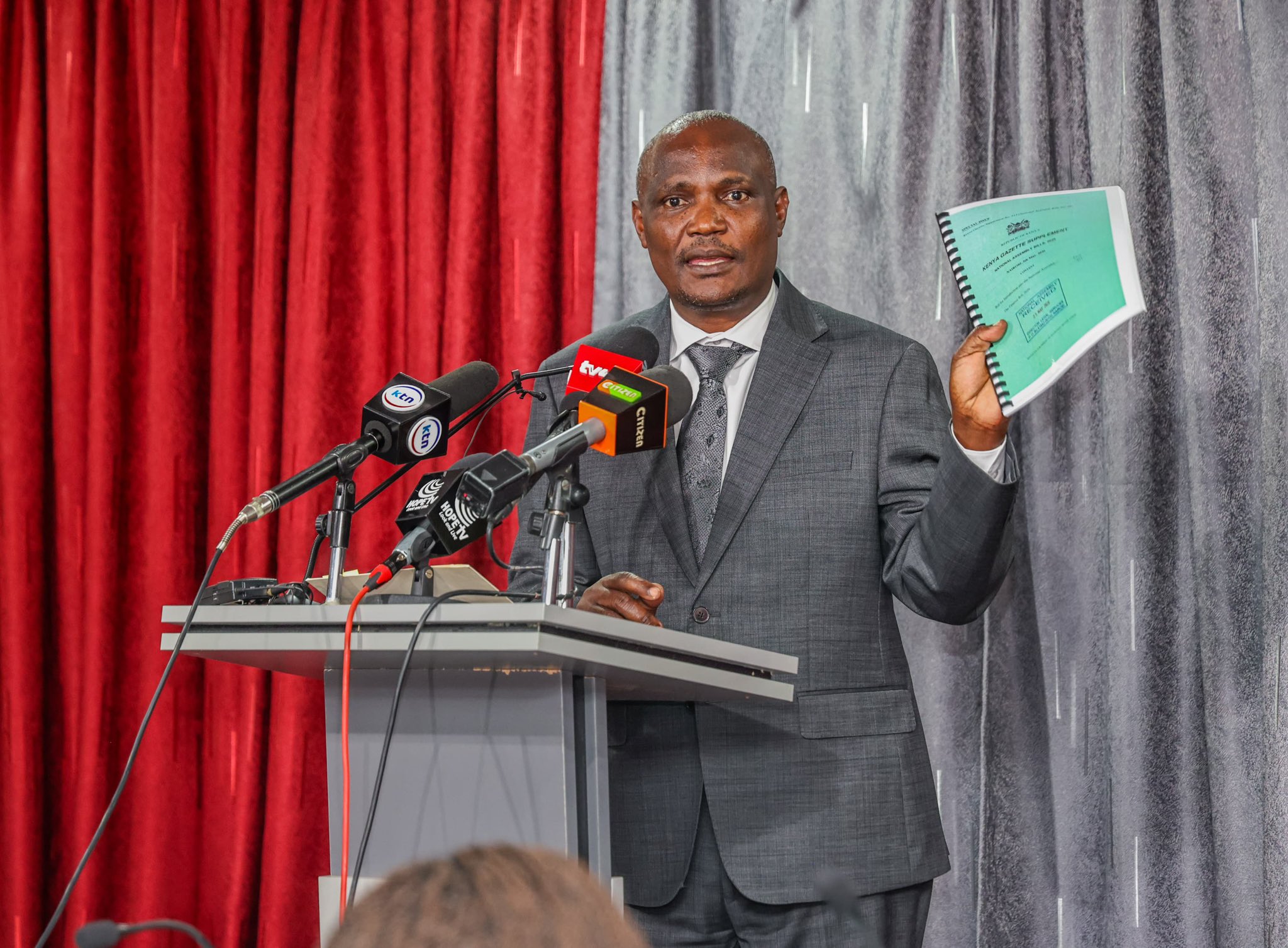
Kenya has begun work on its next Finance Bill months earlier than usual, giving citizens, businesses and other groups an unusually early opportunity to influence the country's tax policy.
The National Treasury is asking Kenyans to submit proposals on changes they would like to see in tax laws, tax administration and East African Community customs measures.
The deadline is 31 August 2026.
But there is an important point to understand: Treasury has not yet published the Finance Bill 2027 and has not announced a final list of new taxes.

At this stage, it is collecting ideas and recommendations that could inform the legislation.
The process has been brought forward because 2027 is a general election year. Treasury says it wants the Finance Act 2027 enacted before Parliament breaks ahead of the elections.
Under the accelerated timetable, preparation of the Finance Bill began in August 2026, with the completed Bill expected to be submitted to the National Assembly in January 2027.
For millions of Kenyans, the process matters because decisions made over the coming months could eventually affect how much they pay in income tax, the cost of goods and services, the cost of doing business and the price of imported products.
What is Treasury asking Kenyans to do?
The Treasury notice is broader than simply asking whether people want higher or lower taxes.
It is inviting proposals for specific amendments to tax laws or tax administration measures.
It is also seeking views on EAC customs measures, including changes to the Common External Tariff, the Duty Remission Scheme and other customs policy instruments.
Anyone submitting a proposal is expected to explain:
-
Which tax law or provision should be changed
-
What problem the proposed change would address
-
Why the change is justified, preferably with evidence or analysis
-
Where relevant, which EAC customs tariff line or policy instrument is affected
Treasury says proposals should be realistic and fiscally responsible, taking into account Kenya's economic conditions, including pressure on government spending, debt and revenue collection.
That means a submission saying simply “reduce all taxes” is unlikely to meet the spirit of the exercise.
A stronger proposal would identify a particular tax, explain the problem it creates and demonstrate what changing it could achieve.
Does this mean new taxes are coming?
Not necessarily.
This is one of the most important distinctions for taxpayers following the story.
Treasury is asking for proposals. It has not said that every proposal received will become government policy.
The eventual Finance Bill will contain measures selected by the government after reviewing the submissions and completing its budget process. It will then have to go through Parliament, where MPs can debate and amend legislation.
So headlines suggesting that Treasury has already announced a new tax in the Finance Bill 2027 would be premature.
The current process is better understood as the opening stage of the tax-policy process.
Why is the process starting so early?
The answer is politics — but not necessarily in the sense of a particular tax proposal.
Kenya is due to hold its next general election on 10 August 2027.
Treasury says the election calendar means the normal budget timetable needs to be accelerated so that the Finance Act 2027 is enacted before Parliament breaks in preparation for the polls.
The Treasury notice says preparation of the Finance Bill began in August 2026, with submission to the National Assembly targeted for January 2027.
That is significantly earlier than the point at which many Kenyans normally begin paying attention to the Finance Bill.
The consequence is important:
By the time the public sees the final tax proposals in Parliament, much of the underlying policy work may already have been done.
That makes the current consultation window particularly important for people who want to influence the process.
What about PAYE and salaries?
The Finance Bill process is taking place alongside a separate discussion about Pay As You Earn, or PAYE.
Treasury Cabinet Secretary John Mbadi said in August that the government was considering changes to PAYE and intended to take proposed legislation to Parliament by the end of September.
Treasury has previously considered raising the tax-free PAYE threshold from KSh24,000 to KSh30,000 and reducing the PAYE rate applying to income between KSh30,000 and KSh50,000.
Those proposals should not, however, be confused with a final Finance Bill 2027.
The government is still consulting stakeholders on the structure of the reforms.
Business groups have also proposed wider changes.
The Kenya Bankers Association, for example, has advocated a 5% reduction in PAYE across income-tax bands, while the Federation of Kenya Employers has called for broader PAYE bands and lower tax rates.
That creates an important policy question:
Should tax relief be targeted at lower-income workers or spread across a wider group of taxpayers?
The answer will have consequences for both household incomes and government revenue.
Why does PAYE matter so much?
PAYE is deducted directly from the salaries of employees.
For workers, a change in the PAYE system can therefore have an immediate effect on take-home pay.
For government, however, income-tax relief comes with a cost.
Treasury estimates reported in August put the annual revenue impact of raising the tax-free threshold to KSh30,000 at about KSh35bn.
That illustrates the central problem facing policymakers.
A government can reduce the tax burden on households, but it must then decide how to replace the lost revenue — or reduce spending.
That debate will be particularly important as Kenya attempts to narrow its budget deficit while continuing to finance public services and debt obligations.
Kenya's tax dilemma
The early start to the Finance Bill comes against a difficult fiscal backdrop.
Treasury's draft outlook for 2027/28 projects total government expenditure and net lending at about KSh5.323 trillion, compared with projected revenue of about KSh3.943 trillion.
That leaves a projected financing gap of roughly KSh1.321 trillion.
Treasury expects most of that deficit financing to come from domestic borrowing, with about KSh1.085 trillion projected from the domestic market and KSh235.9bn from external sources.
That makes tax policy a balancing act.
The government wants to raise enough revenue to fund services and reduce its reliance on borrowing.
At the same time, households and businesses are pushing for lower taxes and relief from the cost of living and operating in the economy.
The Finance Bill will sit directly in the middle of that tension.
Could the Finance Bill lower taxes?
Yes.
There is nothing in the current Treasury invitation that says proposals must involve tax increases.
The government is asking stakeholders to identify changes that could improve the tax system.
That could include proposals to:
-
reduce or restructure particular taxes;
-
remove provisions that businesses consider unnecessarily costly;
-
simplify tax administration;
-
address inconsistencies in tax law;
-
improve compliance;
-
change customs duties;
-
improve incentives for investment;
-
or close loopholes that allow revenue to be lost.
Treasury says proposals should support domestic revenue mobilisation, regional competitiveness and equitable and sustainable economic growth.
So the public consultation is potentially an opportunity to argue for lower taxes in one area while proposing stronger collection or compliance elsewhere.
What could businesses ask for?
Businesses have a particular interest in the customs component of the consultation.
Manufacturers and importers, for example, can make proposals concerning tariffs and duty-remission arrangements affecting the cost of raw materials and equipment.
The Treasury is specifically inviting proposals on the EAC Common External Tariff, the Duty Remission Scheme and other regional customs measures.
For a manufacturer, a change in the tariff applied to an imported input can affect production costs.
For an importer, customs policy can affect the final price of goods.
For consumers, those costs can eventually feed through to shop prices.
This is why the Finance Bill process is not only about the amount deducted from someone's payslip.
It can also affect the prices businesses face and, indirectly, the prices consumers pay.
What does public participation actually mean?
Public participation is not simply a political courtesy.
Kenya's Constitution requires openness and accountability in public finance, including public participation.
The Treasury notice also cites Article 232 of the Constitution and section 35(2) of the Public Finance Management Act as part of the legal basis for involving the public in the budget process.
But submitting an idea does not guarantee that it will appear in the final Bill.
Treasury must consider the proposals, develop policy options and eventually formulate legislation.
The Finance Bill then goes to Parliament, where MPs have their own constitutional and legislative role.
How can a Kenyan submit a proposal?
Treasury's current invitation is open to a wide range of participants.
It specifically mentions:
-
members of the public;
-
national and county governments;
-
NGOs;
-
civil society organisations;
-
professional bodies;
-
private-sector organisations;
-
religious groups;
-
and other stakeholders.
Submissions can be made physically to the National Treasury or electronically.
The Treasury notice gives submissions@treasury.go.ke as the email address and sets 31 August 2026 as the deadline.
For anyone intending to participate, the most useful approach is to make the proposal specific.
Instead of writing:
“Taxes are too high.”
A stronger submission would identify the particular tax provision, explain its effect and provide evidence supporting the proposed amendment.
That is consistent with Treasury's own requirements.
What happens after 31 August?
The end of the public consultation does not mean the tax decisions are finished.
Treasury will have to review the proposals and develop the policy measures that will form the basis of the Finance Bill.
Under the accelerated timetable, the Bill is expected to reach the National Assembly in January 2027.
From there, Parliament will scrutinise the legislation.
That means there will be further opportunities for debate, amendments and public discussion before the final law is enacted.
The exact contents of the Bill, therefore, cannot yet be known.
Why Kenyans should pay attention now
In previous years, public attention often intensifies when the Finance Bill is already in Parliament.
By then, many of the government's preferred measures have already been developed.
The 2027 process is different.
The consultation is happening months earlier, partly because of the election calendar.
That gives citizens and organisations an opportunity to raise issues before the legislation reaches the National Assembly.
It also means that the coming months could provide an early indication of the government's priorities for the final year before the 2027 election.
What we know — and what we don't
We know:
The Finance Bill 2027 process has begun.
Treasury began preparations in August 2026.
Kenyans can submit proposals.
The consultation covers domestic tax laws, tax administration and EAC customs measures.
The deadline is 31 August 2026.
Submissions are due by that date.
The timetable has been accelerated.
Treasury plans to submit the Bill to Parliament in January 2027 because of the election-year calendar.
PAYE reforms are also being considered.
Treasury is consulting on proposed changes, but those reforms are not yet final legislation.
We do not yet know:
Which new taxes, if any, will ultimately be proposed.
Which tax cuts or relief measures Treasury will accept.
Which public submissions will make it into the final Bill.
What amendments Parliament will eventually make.
Those questions will only become clearer as the budget process progresses.
The bigger question for Kenya
The Finance Bill 2027 will ultimately have to answer a question that goes beyond individual taxes:
How does Kenya raise enough money to finance government without placing too much pressure on households, businesses and economic growth?
The government needs revenue.
Workers want higher disposable incomes.
Businesses want lower operating costs.
Investors want predictable rules.
And taxpayers want to know that the money collected from them is being used efficiently.
Those interests do not always point in the same direction.
That is why the public consultation now under way matters.
The deadline may be 31 August, but the decisions that follow could shape Kenya's tax system well beyond the 2027 election.
What LiveNow Africa will be watching
LiveNow Africa will track the process through each stage — from public submissions and PAYE proposals to the January Bill, parliamentary amendments and the eventual Finance Act.
For taxpayers, the most important thing at this stage is simple:
The Finance Bill 2027 has not been finalised. But the process that could determine what is in it has already begun.
Related Stories
- From 70 Seats to 26: Ruto’s Presidential Jet Gets a Major Makeover
- World Bank bars firm behind Kenya’s eCitizen platform over procurement violations
- Your Bank Is Holding Billions in Government Debt: What the World Bank Warning Means for Your Money
Category: Business · Related Topic: Kenya Politics
 Facebook
 Twitter / X
 WhatsApp
 LinkedIn
 Telegram
 Reddit