
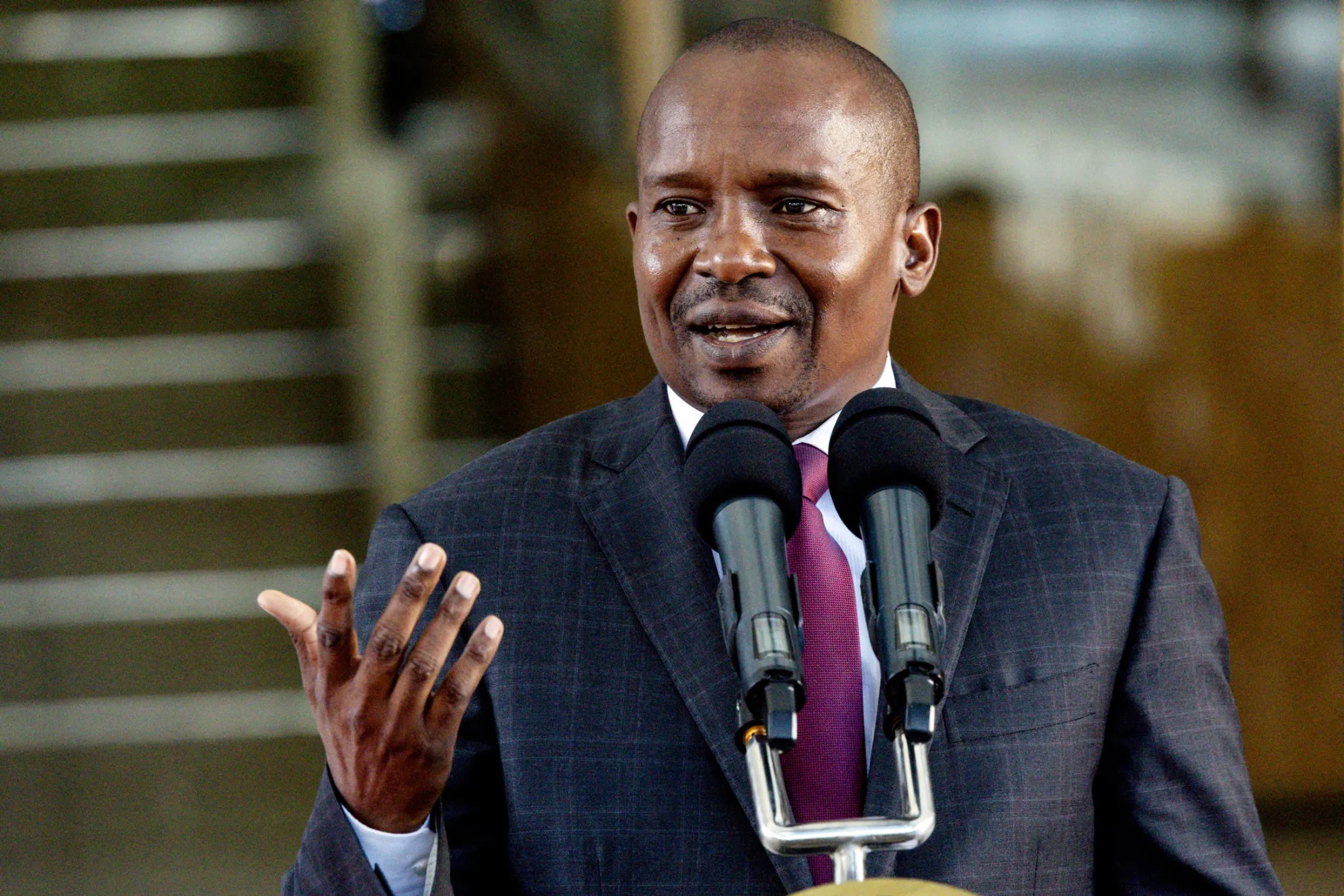
NAIROBI, Kenya — Deputy President Kithure Kindiki has delivered his clearest warning yet that he will not quietly surrender his position as political negotiations over President William Ruto's 2027 running mate gather pace.
Speaking in Tharaka Nithi on Friday, August 21, Kindiki said he would defend his office if there were attempts to remove him.
“I am the fireman, and now, by the grace of God, the Deputy President of Kenya. Do you think there is anybody who can remove me from this seat and chase me away? It is not possible. I will defend myself,” Kindiki said.
His remarks come at a sensitive point in the emerging UDA-ODM political arrangement, with the two parties moving towards a formal coalition for the 2027 election.

The deputy presidency has quickly become one of the most contested pieces of that emerging deal.
Kindiki's message: the seat is not vacant
Kindiki's comments amount to a direct political response to growing discussion about whether ODM could claim the running mate position if it backs Ruto's re-election bid.
ODM leader Oburu Oginga has previously said the party will support Ruto in 2027 rather than field its own presidential candidate.
But ODM has also made clear that it expects to negotiate for senior positions in return.
Oburu has openly expressed interest in becoming Ruto's running mate, saying the deputy presidency should be part of the negotiations.
That has put Kindiki's future at the centre of an increasingly public political contest.
The dispute is not yet a formal contest for the office. The 2027 election is still ahead, and President Ruto has not publicly announced his running mate.
But the competing claims show that the negotiations are already beginning to shape the political landscape.
Kindiki invokes Ruto's own experience
In defending his position, Kindiki pointed to Ruto's experience as deputy president under former President Uhuru Kenyatta.
He recalled the increasingly strained relationship between Ruto and Kenyatta during their second term, when political differences triggered speculation over Ruto's future in government.
“Our President, William Ruto, during the last days, disagreed with his former boss, they tried to remove Ruto, but it was not possible because he had many friends and he was the Deputy President. He stayed firm until the end,” Kindiki said.
He then drew a parallel with his own situation.
“I will defend myself. I cannot simply be chased away; I will defend myself,” he added.
Kindiki's remarks are particularly notable because he was appointed Deputy President after Ruto won the 2022 election, replacing Rigathi Gachagua following his removal from office in 2024.
ODM's claim is becoming harder to ignore
The pressure around the position has been building for weeks.
On August 4, Oburu said ODM would not field a presidential candidate in 2027 and would instead support Ruto.
He then singled out the deputy presidency as a position the party would negotiate for.
“Don't you think I deserve to be number two? Can I not be number two?” Oburu asked at State House.
ODM Deputy Party Leader Simba Arati has gone further, saying the party wants what he described as a 50-50 arrangement with UDA.
Arati argued that if Ruto remains the presidential candidate, ODM should provide his running mate. He named Oburu, Wycliffe Oparanya and Hassan Joho among leaders who could potentially take the role.
The latest position, however, is not entirely straightforward.
Just days after making his pitch, Oburu appeared to soften the personal nature of the demand, assuring Kindiki that ODM was not specifically targeting him.
“We have no problem with DP Kindiki, he is doing a good job,” Oburu said, according to NTV. He added that ODM's focus was on negotiating what it considers a fair political arrangement.
That leaves the political question unresolved: can ODM demand the deputy presidency without displacing the man currently occupying it?
Ruto has not made the final call
Ultimately, the decision on who runs alongside Ruto would be his.
Kenya's Constitution provides that a presidential candidate nominates a person to be elected as deputy president on the same ticket.
That makes the current political bargaining significant, but not decisive.
UDA and ODM have, however, moved beyond loose cooperation.
Earlier this month, Ruto and Oburu unveiled joint teams tasked with preparing a coalition framework and a common manifesto for the 2027 election.
The coalition talks therefore have the potential to turn the question of Ruto's running mate into a formal negotiation between the two political formations.
For Kindiki, that creates an unusual political challenge.
He is not simply defending a government position. He is seeking to remain on the ticket in an election that is still more than a year away.
Kindiki's political argument
Kindiki also used his address to criticise opponents who, he said, were more interested in personal attacks and nicknames than offering competing policy ideas.
He urged government and party officials to communicate the administration's record to voters and promote UDA as it prepares for the next election.
That puts the deputy president firmly into the campaign conversation, even as the formal 2027 campaign period remains ahead.
His argument is likely to centre on continuity: that he is already serving as Ruto's deputy and should be allowed to continue rather than have the position become a bargaining chip.
That position has supporters within government.
Public Service Cabinet Secretary Geoffrey Ruku has previously backed Kindiki's continuation, saying he should remain Deputy President through the 2027 election and into a second Ruto term if the President wins.
A political battle with no final winner yet
There is another factor working in Kindiki's favour.
A July 2026 Infotrak poll reported by Kenyan media placed Kindiki ahead of other potential contenders when respondents were asked about their preferred running mate for Ruto. He was reported to have received 34 per cent support nationally, ahead of Gladys Wanga at 11 per cent and Oburu at five per cent.
But such polling does not determine who will appear on the ballot.
The final choice will depend on political negotiations, coalition agreements, regional calculations, party interests and, ultimately, Ruto's decision.
For now, the most important development is that Kindiki has publicly made his position clear.
He intends to fight for the seat.
And with ODM openly negotiating for the same political space, the Deputy President's office is shaping up to be one of the biggest tests of the emerging Ruto-ODM alliance before Kenyans even get to the ballot box.
Related Stories
- Gachagua seeks Kalonzo alliance as ‘cousins’ politics reshape Kenya’s 2027 contest
- From music to politics: Samidoh sets sights on Ol Joro Orok seat
- Owalo Pitches ‘Third Liberation’ as He Takes Aim at Tribal Politics and Kenya’s Old Political Order
Category: Politics · Related Topic: William Ruto
About the Author
Maureen Onyango is a journalist passionate about storytelling, life coaching and spiritual lessons. She studied at the Kenya Institute of Management and enjoys telling stories that inform, inspire and empower communities.
 Facebook
 Twitter / X
 WhatsApp
 LinkedIn
 Telegram
 Reddit