
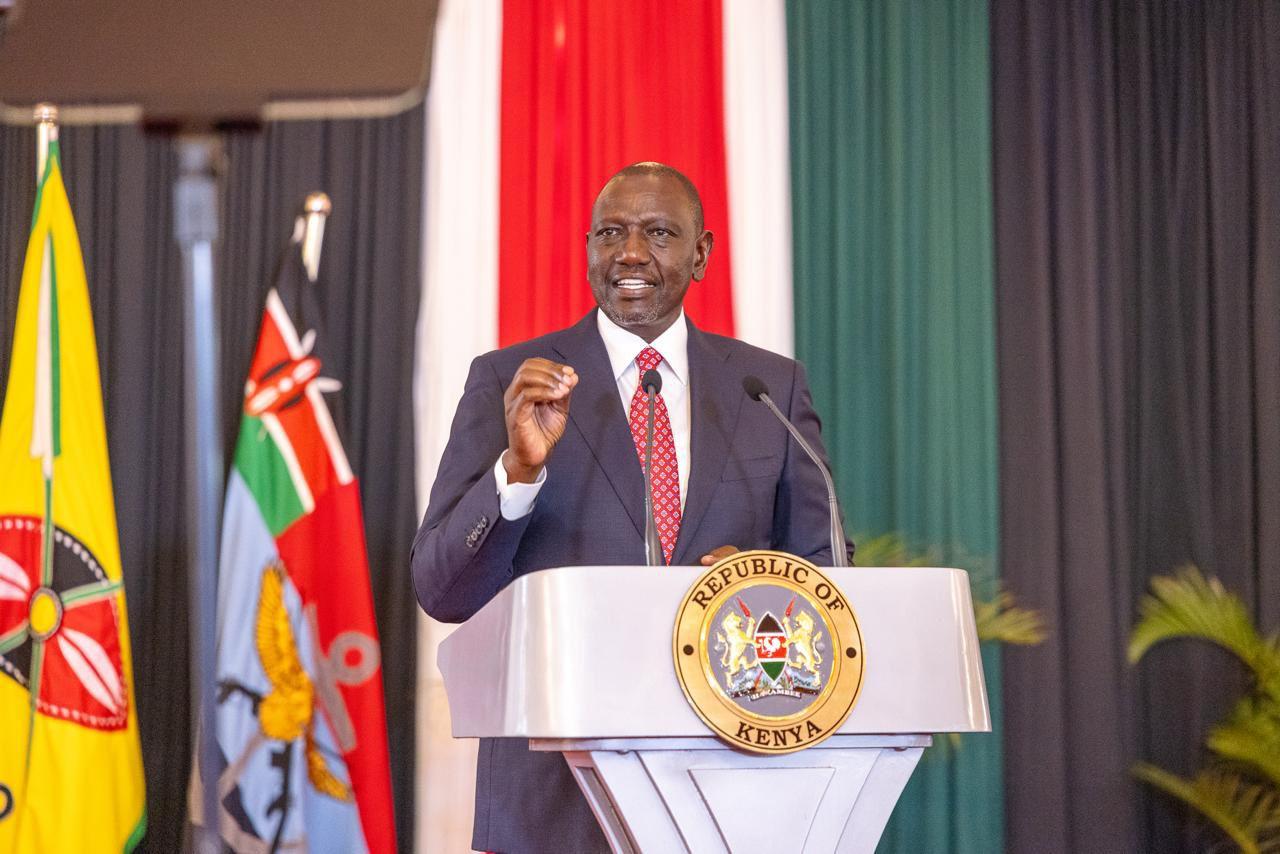
President William Ruto's ambition to transform Kenya into a developed, industrialised "First World" nation may ultimately face a test that has little to do with roads, factories, technology or agriculture.
It is political.
The roadmap prepared at the President's request envisages a transformation that could take 30 to 40 years — potentially stretching across several presidential administrations and generations of political leaders.
And the authors of the plan know this is where Kenya's previous development ambitions have repeatedly struggled.
The document identifies policy discontinuity, institutional weakness and political disruption as some of the central reasons Kenya has failed to sustain development momentum.
Its warning is blunt: development transformation happens over decades, not electoral cycles.
That raises the uncomfortable question at the heart of President Ruto's latest economic vision:
Can a 30-year national project survive Kenya's next election — let alone the elections after that?
Kenya's history offers little comfort
Kenya is not starting from zero.
The country has had successive development blueprints, including the post-independence five-year plans, the Economic Recovery Strategy for Wealth and Employment Creation, Vision 2030 and, most recently, the Bottom-Up Economic Transformation Agenda.
The new roadmap argues that the problem has often not been a shortage of ideas.
Instead, development priorities have become associated with individual governments, while incoming administrations have frequently changed priorities, restructured institutions or introduced new programmes before previous initiatives had matured.
The result, according to the report, has been a cycle of progress, stagnation and renewed attempts to recover lost ground — often around election periods.
That experience is particularly relevant to Ruto's proposal.
The President's new ambition is not a five-year programme. It is a generational project.
The roadmap envisages moving Kenya from a lower-middle-income economy to a high-income, industrialised and globally competitive country through three main engines: agricultural transformation, manufacturing and agro-processing, and technology and innovation.
But those changes cannot realistically be completed during one presidential term.
The plan's biggest test may be the president who comes after Ruto
The roadmap appears to recognise this problem.
It proposes that the new national vision should not belong to one administration but should become a national project shared across political transitions.
That is why it recommends a national development law.
The proposed law would establish the long-term objectives of the vision and require future national development plans, Medium-Term Plans, county development plans, sector strategies and annual budgets to align with it.
Crucially, the proposed legislation would include safeguards intended to preserve implementation beyond electoral cycles.
In other words, the authors appear to be attempting to solve politically what has previously been treated as an economic problem.
The question is whether legislation can force political continuity.
The NESC comeback
Another significant proposal is the revival and strengthening of the National Economic and Social Council (NESC).
The council would provide strategic oversight, coordinate implementation and help maintain focus on long-term development priorities beyond electoral cycles.
That idea has historical significance.
NESC played a role in Kenya's economic policy formulation during the Kibaki administration and was involved in the development of Vision 2030. The new report notes that the council was effectively put to rest after 2013.
The new proposal therefore goes beyond creating another government committee.
It is an attempt to create an institutional mechanism that can outlive individual administrations.
The proposed architecture would also include a Vision Delivery Secretariat responsible for strategic planning, monitoring, data management, performance tracking, stakeholder engagement and annual progress reporting.
But again, the crucial question is political independence.
Will such institutions belong to the country — or to the administration that creates them?
The Vision 2030 warning
There is already a cautionary example.
Vision 2030 was itself intended to provide Kenya with a long-term development direction.
It targeted an average annual economic growth rate of 10%, alongside industrialisation, improved living standards and expanded social services.
But the new roadmap acknowledges that Kenya did not achieve the 10% growth target.
While Vision 2030 delivered significant gains in infrastructure, ICT, basic services and devolution, progress in industrialisation, productive employment, poverty reduction and economic transformation was slower than originally envisaged.
Manufacturing, in particular, remains below the ambitions set for it.
The lesson for Ruto's plan is obvious: having a long-term vision is not the same thing as maintaining long-term implementation.
The election cycle problem
Kenya's political economy makes the challenge even harder.
Presidential elections create powerful incentives for governments to demonstrate visible results within a limited period.
Roads, housing projects, health facilities, schools and other infrastructure can produce tangible political returns.
But industrial policy, human-capital development, technology research, institutional reform and productivity improvements may take decades before their full impact becomes visible.
That creates a tension between what wins elections and what transforms economies.
The roadmap itself argues that political transitions should not lead to the abandonment of national development priorities.
The challenge is how to make that principle work in practice.
A future administration could inherit Ruto's programme and decide that its own economic philosophy is different.
It could rename programmes, redirect spending, restructure institutions or shift investment priorities.
Even county governments could complicate implementation because many areas central to the proposed transformation — including agriculture, health, urban development, water and local infrastructure — involve devolved or shared responsibilities.
Can Ruto build something bigger than himself?
This may ultimately become the defining test of the President's First World project.
If the vision is presented primarily as Ruto's plan, its survival may depend on Ruto remaining politically influential.
If it becomes a legally protected, nationally owned development strategy supported by institutions, counties, businesses, universities, civil society and successive political parties, it has a better chance of surviving political change.
The authors appear to understand this distinction.
The report says Kenya needs a development vision that is not tied to one administration but owned by the country and respected across political transitions.
It also calls for national consultation and consensus-building as part of the implementation process.
That could be more important than any individual infrastructure project.
The opposition's future role
For Kenya's opposition, the proposal creates an interesting political dilemma.
Should an opposition party reject a long-term development strategy simply because it was initiated by President Ruto?
Or should it support the national objectives while challenging the government's methods, financing choices, implementation and accountability?
The second approach could potentially create a more durable national consensus.
Kenya's development history suggests that abandoning every predecessor's programme can be just as damaging as defending every government project.
The real test should therefore be whether Kenya can distinguish between a government's political agenda and a country's long-term development interests.
The real question is bigger than Ruto
President Ruto may be the political leader who launches Kenya's next long-term development vision.
But he cannot be the leader who completes it.
If the proposed transformation takes 30–40 years, its ultimate outcome will be determined by presidents who have not yet been elected, ministers who have not yet entered politics and citizens who may not yet have reached adulthood.
That means the success of the plan may depend less on whether Ruto can sell the vision today and more on whether he can build institutions capable of continuing it tomorrow.
Kenya's previous experience provides the warning.
Its development plans have often failed not because the country lacked ambition, but because political transitions repeatedly disrupted continuity.
The new roadmap attempts to address that weakness through law, institutions, monitoring and national consensus.
But legislation alone cannot create political commitment.
The next president will ultimately have to decide whether Ruto's First World ambition is worth continuing.
And that is why Kenya's most important test of the plan may not come in 2030, 2040 or 2050.
It may begin at the ballot box in 2027.
The question Kenyans should now be asking
The central question is therefore not simply:
Can Ruto make Kenya First World?
It is:
Can Kenya build a First World development project that survives Ruto?
That distinction could determine whether this becomes another ambitious document in Kenya's long history of development plans — or the beginning of the country's longest sustained transformation.
 Facebook
 Twitter / X
 WhatsApp
 LinkedIn
 Telegram
 Reddit