
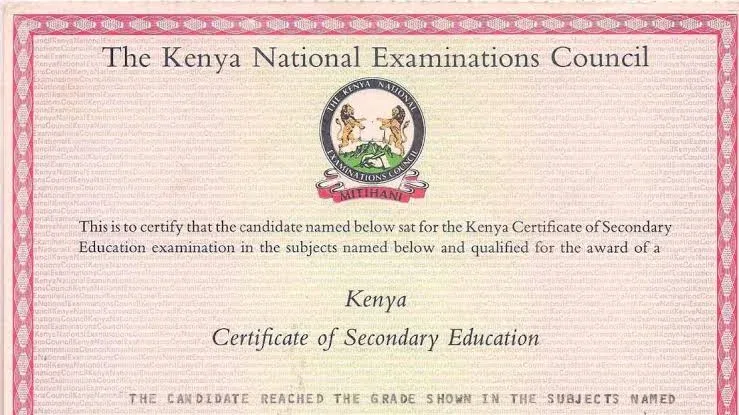
The Kenya National Examinations Council (KNEC) has released new guidelines outlining how employers, universities and other organisations can verify Kenya Certificate of Secondary Education (KCSE) certificates through its recently launched e-Certificate platform.
The move is expected to simplify the verification process while strengthening efforts to curb the use of forged academic credentials in employment, admissions and other official applications.
Under the new guidelines, organisations must first register as verifier organisations before they can access the online service.
The registration process requires applicants to submit their organisation's details through the platform before requesting a one-time password (OTP). A six-digit verification code sent to the registered email address must then be entered to activate the application.
Applicants are also required to upload a valid certificate of incorporation before submitting their registration for review.
KNEC will assess the information provided and either approve the application or reject it with reasons, allowing organisations to correct any errors before reapplying.
Once approved, organisations gain access to a verifier dashboard where they can begin submitting certificate verification requests.
To verify a KCSE certificate, users must provide the candidate's index number, examination year, examination type and full name exactly as it appears on the certificate. They must also upload the candidate's digital certificate in PDF format before completing the request.
The platform supports bulk verification, allowing organisations to submit multiple certificates under a single application.
Before finalising a request, users must specify the purpose of the verification, such as employment, university admission or immigration, and confirm a consent declaration.
Payments can be made using account credits or through the eCitizen platform using mobile money and other supported payment methods.
After processing, the system generates a verification report indicating whether a certificate has been confirmed as authentic or referred to KNEC for further review.
The new guidance comes as scrutiny of academic qualifications continues to grow following several high-profile cases involving forged certificates.
Earlier this month, two former employees of the Independent Electoral and Boundaries Commission (IEBC) were convicted in separate cases after courts found they had used fake academic certificates to secure employment and promotions in the public service.
KNEC says the digital verification platform is intended to make it easier for institutions to authenticate academic credentials while improving confidence in Kenya's examination certification system.
 Facebook
 Twitter / X
 WhatsApp
 LinkedIn
 Telegram
 Reddit