
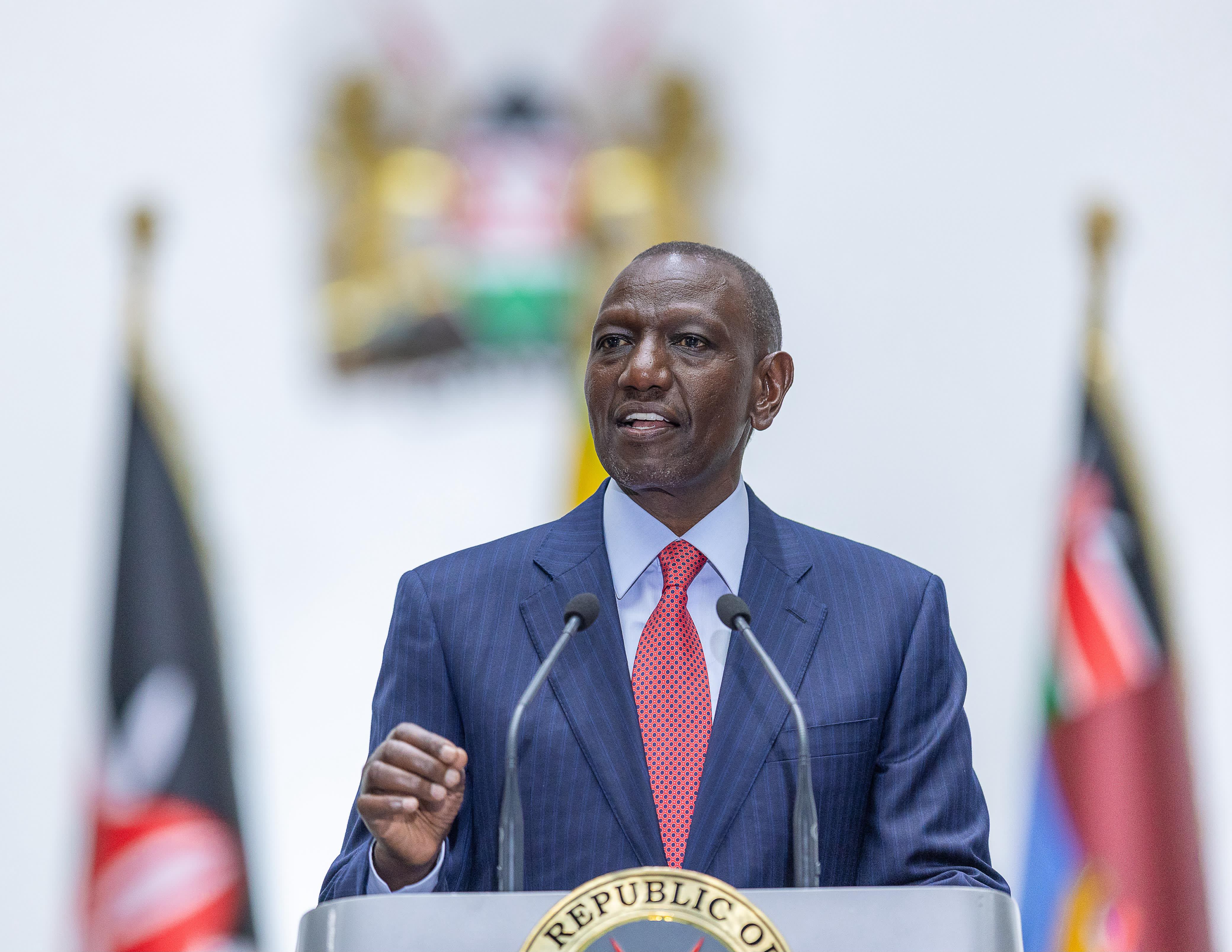
President William Ruto has called for a new national conversation on Kenya's long-term development, saying the country must begin preparing a development charter to succeed Vision 2030.
In a televised national address on Thursday, President Ruto said the process would seek to define the kind of Kenya the country wants to build for future generations and translate the development promises contained in the 2010 Constitution into measurable outcomes.
He announced that the National Conversation on Kenya's Future Beyond Vision 2030 will formally begin on 12 August 2026.
The president described the exercise as one of the most significant national conversations since the adoption of the Constitution in 2010.
"This is a national undertaking about the future of our Republic," he said, arguing that the discussion should rise above politics and electoral cycles.
Vision 2030 approaching its deadline
Kenya's Vision 2030 has provided the country's overarching development framework for two decades, guiding government policy and investment.
But President Ruto acknowledged that the country has not achieved all the targets set under the plan.
One of its major ambitions was for Kenya to become an upper-middle-income economy by 2030. The president said the country remains off target.
Rather than abandoning the long-term planning approach, he argued that Kenya should use the experience gained from Vision 2030 to develop a new framework that extends beyond 2030.
"Honesty also requires us to acknowledge that some of its ambitions remain unattained," he said.
Ruto points to missed economic opportunities
The president used the address to compare Kenya's economic performance with countries that, he said, had successfully taken advantage of major waves of global economic transformation.
He cited South Korea, China, Vietnam and Bangladesh as examples of countries that had transformed their economies through reforms, industrialisation, exports and investment.
Ruto said Kenya had been present during these periods of global economic change but had failed to fully capitalise on them.
He highlighted the difference between Kenya and South Korea, saying the two countries had similar levels of GDP per capita in 1965, but South Korea had since moved significantly further ahead.
The president said Kenya now had another opportunity, arguing that Africa could be at the centre of the next major wave of global economic growth.
He pointed to Africa's young population, natural resources, renewable energy potential, agricultural capacity and expanding consumer markets as factors that could drive the continent's transformation.
President says economy has been stabilised
Ruto also used the address to defend his administration's economic record.
He said Kenya had restored macroeconomic stability, stabilised the shilling and increased foreign exchange reserves to more than $15bn, equivalent to about six-and-a-half months of import cover.
He also said inflation had fallen, borrowing costs had declined and investor confidence had returned.
According to the president, Kenya attracted a record $3.2bn in foreign direct investment in 2025, more than twice the amount recorded in 2022.
He also cited Kenya's position in the 2025 IMD World Competitiveness Ranking, saying the country had been ranked Africa's most competitive economy.
The claims form part of the government's broader argument that the country has moved from economic stabilisation towards a phase of long-term transformation.
Constitution at the centre of new vision
A central theme of the president's address was that Kenya's next development strategy should be rooted in the Constitution rather than being simply another government plan.
Ruto pointed specifically to constitutional commitments on human rights, equality, democracy, social justice and the rule of law.
He also referred to Article 43, which provides for economic and social rights including healthcare, housing, food, water, social security and education.
The president said Kenya now needed to establish measurable standards for determining whether these constitutional guarantees were being realised in people's daily lives.
"Development, therefore, is not simply a policy preference of those who govern. It is a constitutional imperative for the governed," he said.
A people-driven process
Ruto said the new vision should not be written solely by government officials, politicians or experts.
He called for participation by farmers, workers, entrepreneurs, academics, professionals, faith groups, civil society organisations and young people.
He said he had already consulted current and former political leaders, business leaders, scholars, religious leaders and young Kenyans from across the country.
The president also disclosed that he had asked Professor Hiroyuki Hino, Professor Anyang' Nyong'o and other experts to examine Kenya's future beyond Vision 2030.
He said the experts had presented proposals for Kenya's long-term transformation.
According to Ruto, their central proposition is that Kenya can become a prosperous, high-income, industrialised and globally competitive country within one generation, provided it maintains long-term focus and disciplined implementation.
National conversation begins in August
The president announced that the formal national conversation will begin on Wednesday, 12 August.
Political parties, counties, businesses, workers' organisations, religious institutions, universities, professional bodies, innovators, civil society and the creative sector are expected to participate.
Young people, he said, would be placed at the centre of the process.
The proposed exercise comes at a politically sensitive period, with Kenya already beginning to position itself for the 2027 General Election.
Ruto insisted, however, that the development conversation should transcend electoral politics and produce a framework that survives changes in government.
He argued that national development should not be dictated by short-term political priorities or changing administrations.
A test of implementation
The president's proposal now faces a more difficult question: whether the planned national conversation can translate into a durable development framework with measurable targets and broad public ownership.
Kenya has previously produced ambitious long-term development plans, including Vision 2030, but Ruto himself acknowledged that some of its objectives remain unmet.
His new proposal therefore seeks to move beyond setting aspirations towards establishing clear standards against which future governments can be judged.
The president framed the challenge as a generational one.
"If the defining achievement of those who came before us was to give Kenya a Constitution worthy of our aspirations, then the defining responsibility of our generation is to build a nation worthy of that Constitution," he said.
The national conversation is expected to begin on 12 August, opening what the president described as a process to determine Kenya's development direction beyond 2030.
 Facebook
 Twitter / X
 WhatsApp
 LinkedIn
 Telegram
 Reddit