
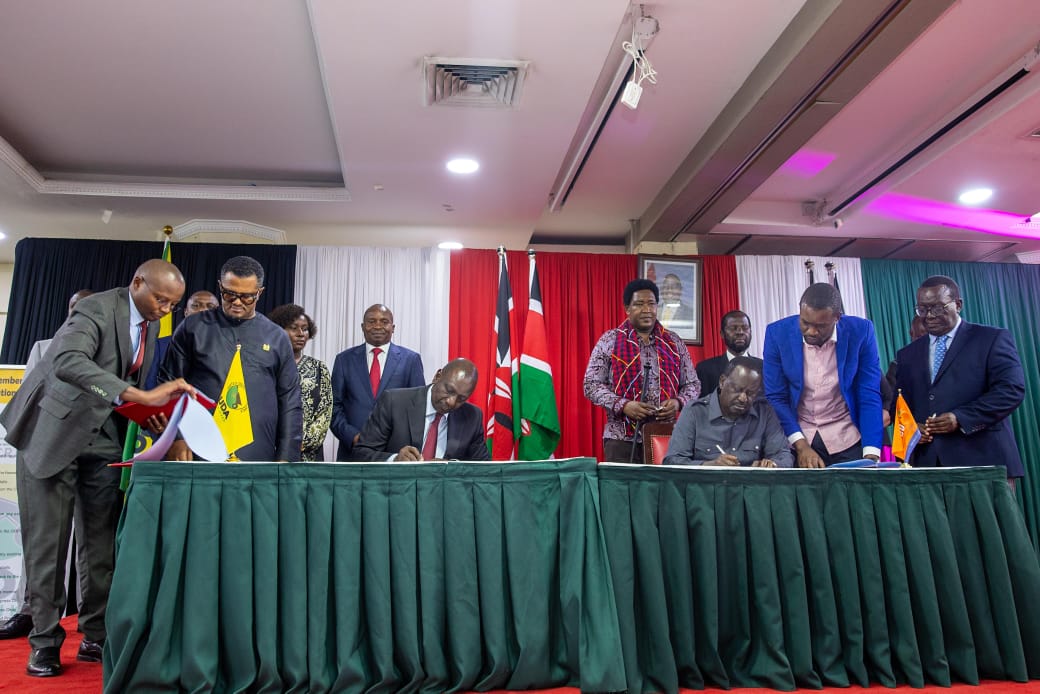
In a rare show of unity, President William Ruto and opposition leader Raila Odinga have jointly named a five-member committee to oversee the rollout of their far-reaching political agreement signed in March 2025.
The new team, chaired by former nominated senator Dr Agnes Zani, is tasked with implementing a 10-point plan drawn from the Memorandum of Understanding (MoU) between the ruling United Democratic Alliance (UDA) and the Orange Democratic Movement (ODM). The agreement, built on the recommendations of the NADCO (National Dialogue Committee) report, is designed to promote national unity, social justice, and inclusive governance.
Joining Dr Zani are political analyst Gabriel Oguda, former MP Fatuma Ibrahim, youth leader Kevin Kiarie, and governance expert Javas Bigambo. Together, they are expected to serve as the bridge between citizens, government, and civil society.
“The committee shall undertake inclusive and extensive consultations with members of the public and all relevant stakeholders,” read a joint statement issued by Ruto and Odinga. These stakeholders include arms of government, independent commissions, faith-based groups, civil society organisations, and the private sector.
Their work begins immediately.
A Pact Built on Crisis and Consensus
The MoU followed months of national dialogue after last year’s protests over high living costs, youth unemployment, and concerns over public accountability. At its heart is a call for healing and structural reform, including a provision for compensation to victims of past demonstrations.
“This is not about politics. It’s about country,” a senior ODM official, who requested anonymity because he was not authorised to speak publicly, told The Times. “Both sides recognise the cost of instability. Now it’s time to act.”
What the Agenda Covers
The 10-point plan covers a broad spectrum—from taming ballooning national debt to defending the constitutional right to peaceful protest. It also includes:
-
Strengthening devolution and ensuring equitable resource distribution.
-
Promoting youth employment and livelihoods.
-
Enhancing leadership integrity and accountability.
-
Addressing corruption and public sector inefficiency.
-
Reinforcing the rule of law and respect for constitutionalism.
Analysts say the agreement—while politically unusual—could set a precedent for a new era of cooperative governance in Kenya.
“This isn’t a coalition government, but it could serve as a functional bridge between adversaries in the interest of stability,” said Dr Winnie Mitullah, a governance scholar at the University of Nairobi.
Tracking Progress and Accountability
The committee will submit bi-monthly updates to Ruto and Odinga and brief a joint UDA–ODM Parliamentary Group every quarter. The first such sitting is scheduled for 18 August.
A comprehensive report on the MoU’s progress is expected by 7 March 2026, marking exactly one year since the deal was signed.
To support the initiative, both UDA and ODM will jointly fund a secretariat that will handle day-to-day coordination. According to insiders, the secretariat will be headed by representatives from both parties.
Bridging the Political Divide
Though scepticism remains—particularly among younger Kenyans wary of elite bargains—supporters say the effort offers a chance to reset national discourse.
“What we want is accountability, not handshakes,” said Leah Atieno, a university student in Kisumu. “If they deliver on youth jobs and stop the corruption, we’ll support them.”
For now, the spotlight is on the five-member team—and whether they can translate promises into real, measurable change.