
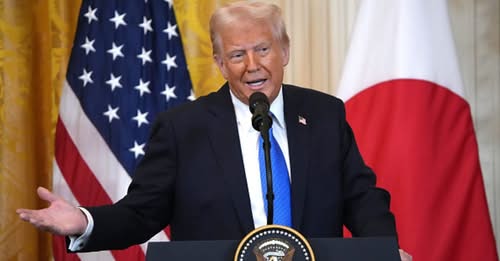
Washington, D.C. — President Donald J. Trump has announced what he described as a “massive” trade agreement between the United States and Japan, signalling a potential breakthrough in ongoing tensions between the two economic powers.
Speaking at a White House event Tuesday evening, Mr Trump claimed the new arrangement would bring $550 billion (£407 billion) in Japanese investment to the U.S. and reduce tariffs on American exports.
“I just signed the largest trade deal in history — I think maybe the largest deal in history with Japan,” Mr Trump told reporters. “It’s a great deal for everybody. I always say it has to be great for everybody.”
The deal, according to the president, will see Japan open its markets further to American cars, trucks, rice, and other agricultural products. A key provision includes a 15% reciprocal tariff on goods, down from the previously threatened 25% that had rattled global markets earlier this year.
In Tokyo, Japanese Prime Minister Shigeru Ishiba confirmed elements of the deal but offered a more cautious tone. “We were the first in the world to reduce tariffs on cars and auto parts without any quantity restrictions,” Mr Ishiba said during a press conference on Wednesday. However, he also clarified that “the agreement does not include any reduction of tariffs on the Japanese side.”
The move is seen by some analysts as a calculated step by Japan to avert a full-blown trade dispute with Washington. “Bringing its main tariff rate down to 15% is Japan’s best compromise at this stage,” said Shigeto Nagai, an economist at Oxford Economics. “The $550bn investment announcement will be a huge boost to Trump’s narrative of reviving American manufacturing.”
Though celebrated by Mr Trump, the full text of the agreement has not yet been released. The BBC reported that it had reached out to both the White House and Japan’s embassy in Washington for clarification on several key details, including timelines and enforcement mechanisms.
Just weeks earlier, Mr Trump had issued a warning to Tokyo, threatening a 25% tariff on all Japanese exports to the U.S. if a new agreement wasn’t in place by 1 August. That threat followed his April announcement of a broader tariff regime — dubbed “Liberation Day” — which sent shockwaves through financial markets and was later paused to allow further negotiations.
The announcement comes at a politically sensitive time for Prime Minister Ishiba. His ruling Liberal Democratic Party (LDP) suffered a major blow over the weekend, losing its majority in Japan’s upper house — a result that followed an earlier defeat in the more influential lower house. The political turmoil has raised questions about his ability to lead on the international stage.
Meanwhile, Japan’s stock market appeared to welcome the deal. The Nikkei 225 index jumped more than 3% in Wednesday trading, with shares in major automakers — including Toyota, Nissan and Honda — recording strong gains.
Still, some observers remain sceptical. Without a publicly available agreement, critics argue that key elements of the deal remain ambiguous.
“This is a big headline, no doubt,” said one Tokyo-based trade expert. “But until we see the actual agreement, it’s hard to know what’s been gained — or what’s been conceded.”
For now, both leaders are claiming victory. Whether the deal delivers on its promises, however, may take months — or years — to fully assess.