
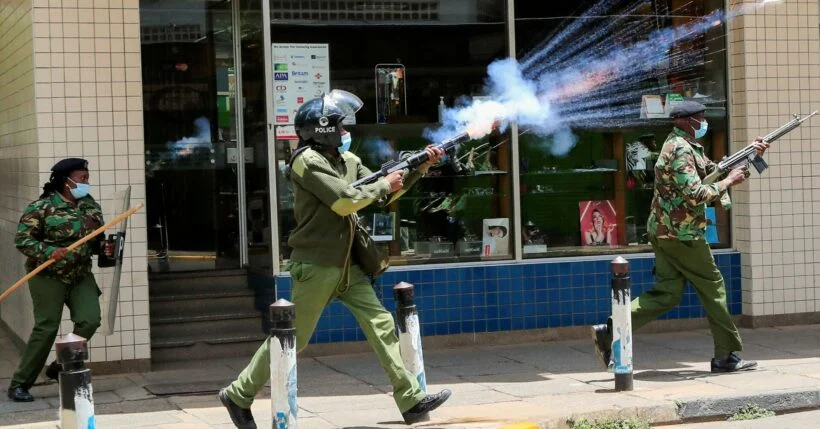
Moses Kuria, President William Ruto’s senior economic advisor, on Wednesday made an unusual appeal to the country’s security forces: hold your fire — and take the unused tear gas back to the station.
As thousands took to the streets in cities across Kenya to mark one year since the deadly anti-Finance Bill protests of 2024, Kuria praised the largely peaceful demonstrations and urged police officers not to escalate tension.
“I am largely happy that Gen Z demonstrations across the country are largely peaceful, as it should be,” Kuria said in a brief statement. “I also want to commend the police for exercising restraint so far.”
He added pointedly: “Not every teargas canister that leaves the station must be used in the streets.”
Kuria’s remarks came just hours after tear gas filled parts of Nairobi’s Central Business District, where police confronted protesters marching in memory of dozens of young Kenyans killed during last year’s unrest.
Tensions on the Ground
Wednesday’s demonstrations were intended as a solemn act of remembrance. Protesters waved flags and held up photographs of those lost in last year’s crackdown. But as crowds swelled, tensions followed. Police fired tear gas near Parliament Road and Kenyatta Avenue, prompting confusion and panic among marchers.
In parts of the capital, the protests took on a more political tone. Former Chief Justice David Maraga, Wiper Party leader Kalonzo Musyoka, and Democratic Action Party leader Eugene Wamalwa joined demonstrators in central Nairobi.
Addressing the press, Maraga was direct in his criticism.
“We strongly condemn the use of state violence against grieving families and peaceful protesters,” he said. “The flagrant violation of the Constitution and human rights must stop.”
Martha Karua, leader of the People’s Liberation Party, added her voice, calling the show of force by police “an act of cowardice.”
Balancing Protest and Policing
The government has insisted that officers on the ground are under clear instruction to avoid confrontation unless provoked. Interior Cabinet Secretary Kithure Kindiki had earlier said the state respected the right to peaceful assembly but would not tolerate lawlessness.
Yet for many protesters, the line between caution and suppression felt increasingly thin.
“The people are peaceful, but the police still attack,” said 24-year-old protester Brian Mwangi, clutching a cloth over his nose near Tom Mboya Street. “Why is it a crime to remember the dead?”
Kuria’s statement, though rare in its tone for a senior government adviser, sought to walk a line — praising the restraint shown so far, but cautioning against heavy-handed tactics as the day wore on.
A Country on Edge
The June 25 anniversary has become more than a day of mourning. For Kenya’s youth — many of them unemployed and disillusioned — it symbolises a broader demand for justice, economic reform, and political accountability.
While Kuria’s words may have been meant to lower the temperature, protesters on the ground remained wary of a government they say has yet to deliver answers or change.
“The police shouldn’t need a reminder to act humanely,” said Esther Muthoni, a volunteer medic near Jevanjee Gardens. “But if they do, I hope they listen.”
As the protests continued into the afternoon, the tear gas lingered — in the air, and in the memory of a country still reckoning with what it means to protest, to govern, and to be heard.