
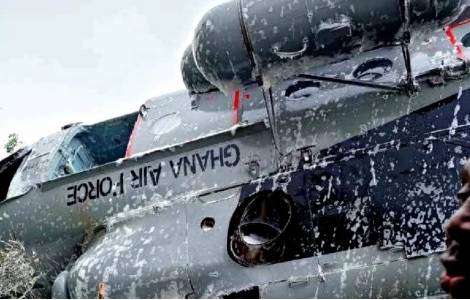
ACCRA, Ghana — The blackened wreckage of a military helicopter lies deep in the forests of Ghana’s Ashanti region, where a devastating crash last week claimed eight lives—including two serving government ministers.
Now, investigators may be closer to finding out what went wrong.
The Ghana Armed Forces have recovered the aircraft’s flight data and cockpit voice recorders, commonly known as black boxes. President John Mahama confirmed the retrieval and said a full, transparent investigation is now underway.
“This is not just a national tragedy—it is a personal one,” the President said in a televised address. “We will get to the bottom of this.”
The Z-9 military helicopter, en route from Accra to the gold-mining town of Obuasi, went down without warning last Friday, 1 August. Heavy fog and low visibility had blanketed the region that morning—conditions that the local meteorological service had already flagged as dangerous.
There were no survivors.
Among the dead were Defence Minister Edward Omane Boamah and Environment, Science and Technology Minister Ibrahim Murtala Muhammed—both considered close allies of the President. Also killed were Alhaji Muniru Mohammed, the Deputy National Security Coordinator, and Samuel Sarpong, Vice-Chairman of the ruling National Democratic Congress.
Eyewitnesses in nearby villages recalled hearing the thud of rotors above the treetops before a sudden explosion tore through the morning air.
“It was flying very low, and the sky was grey,” said one farmer who spoke to the BBC. “Then there was a loud sound—like something snapping—and then a bang. I rushed there, but there was nothing I could do. Everyone was gone.”
The crash is Ghana’s deadliest military aviation incident in recent memory, and the third involving Air Force helicopters in the past five years. It has raised urgent questions about aircraft safety and emergency preparedness.
The remains of the victims have been recovered, and forensic samples have been flown to South Africa for further identification—a step that underscores the extent of the damage.
A state funeral has been scheduled for 15 August, where the President is expected to lead the nation in mourning.
While the black boxes may offer clues—recording the crew's final conversations and technical data from the flight—officials have cautioned against drawing early conclusions.
“We must let the process run its course,” a senior defence official told reporters in Accra. “We owe it to the families—and to the country—to understand fully what caused this tragedy.”
For now, flags remain at half-mast, and a nation waits for answers, grieving the sudden loss of its public servants in a forest that now holds both sorrow and silence.
 Facebook
 Twitter / X
 WhatsApp
 LinkedIn
 Telegram
 Reddit