
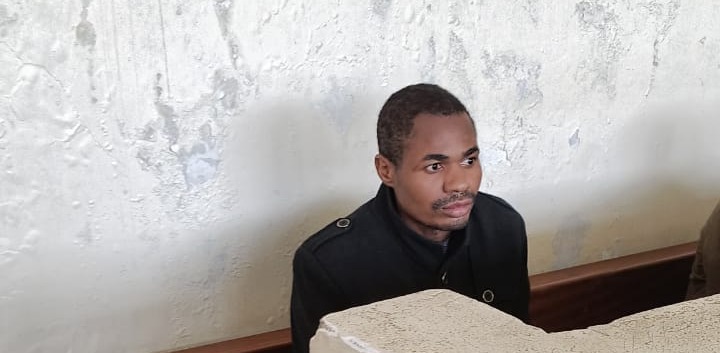
NAIROBI — A man at the centre of a chilling murder investigation at Kenyatta National Hospital will remain in custody for 10 more days as authorities struggle to confirm who he is—or even how unwell he may be.
On Thursday, the Kibera Law Courts ordered that Kennedy Kalombotole be held at Mbagathi Hospital under tight security. The directive came after it emerged that the suspect has no known relatives, fixed home, or official identification.
Magistrate Daisy Mutahi ruled that Kalombotole’s medical condition and mysterious identity left the court with no option.
“The court has considered the health condition of the suspect and the need for secure custody,” said Mutahi. “He shall be detained at Mbagathi Hospital under tight security, with the OCS Kilimani ensuring full supervision.”
The prosecution argued that releasing him posed serious risks. “Kalombotole has no known relatives, no fixed place of residence, and lacks identification documents. It is not safe to release him at this point,” the court heard.
Health in Question
Kalombotole is reportedly diabetic and epileptic, with medical needs that Kilimani Police Station cannot meet. His defence team told the court he had missed critical medication, which triggered seizures during earlier court appearances.
“His medication requires cold storage, which the station cannot provide,” said Prosecutor James Gachoka.
Defence counsel Philip Maiyo opposed Kalombotole’s continued stay at the police station, citing poor facilities. He had initially proposed that the accused be transferred to Mama Lucy Kibaki Hospital or Mbagathi, but not back to KNH.
The court agreed. Prosecutors warned against returning the suspect to Kenyatta National Hospital, where the two alleged murders occurred. “It remains an active crime scene,” they said.
Who Is Kalombotole?
The man’s identity remains a mystery. Authorities say he has no documents to prove who he is. Investigators are now working with the immigration department to determine whether he’s using an alias or forged papers.
“We are working to verify his identity,” the prosecution told the court.
Kalombotole first appeared in court on 24 July. He was arrested six days earlier, following the death of Edward Maingi Ndegwa, found with injuries inside a KNH ward.
A second death is also under investigation. Gilbert Kinyua, another patient, was found with his throat slit in Ward 7B in February 2025. CCTV footage was unavailable at the time, complicating the inquiry.
Detectives now believe both men may have had contact with Kalombotole before their deaths. A post-mortem is pending on Maingi’s body. Investigators have requested DNA samples from the suspect to compare with blood recovered at the scene.
The Defence Pushes Back
Kalombotole’s lawyers argue that he is being treated unfairly because of his medical condition and status as a hospital patient. “Being sick in a public hospital doesn’t make one a killer,” said Maiyo.
The defence has asked the court to review medical records from both KNH and Nairobi Women’s Hospital, where Kalombotole reportedly received earlier treatment.
The case will return to court on 2 August, when the prosecution is expected to present further findings, including results from forensic testing and identity verification.
For now, a man known only by name—and not by history—sits under guard in a hospital ward, at the centre of one of Kenya’s most unsettling murder cases in recent memory.