
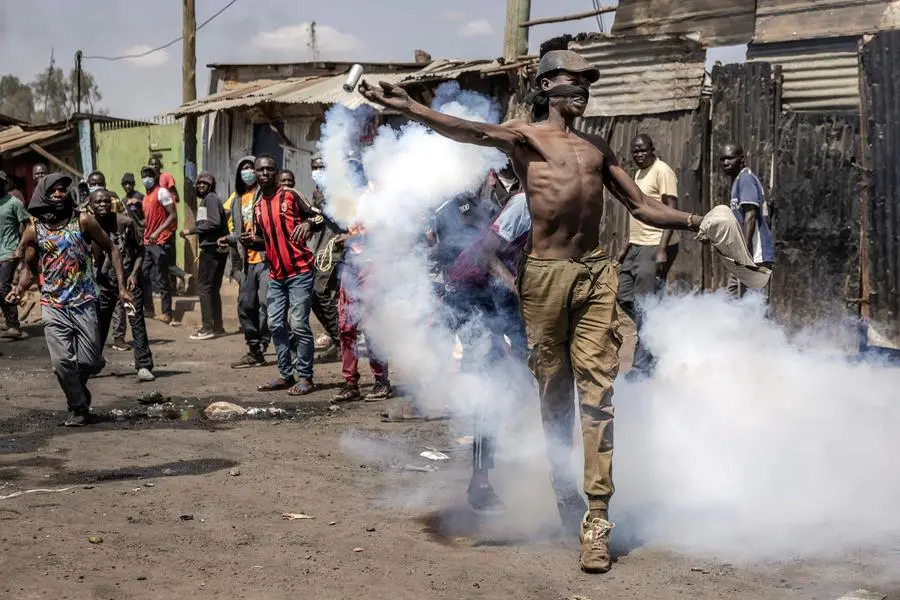
By mid-morning on Wednesday, clouds of tear gas drifted through downtown Nairobi. The sharp cracks of rubber bullets echoed off shuttered shopfronts. And Kenya’s Gen Z, out in their thousands to mark the anniversary of last year’s fatal demonstrations, found themselves once again staring down a heavily armed police force.
They came to remember. They left coughing, bleeding, and furious.

“We are peaceful,” they chanted as they waved miniature Kenyan flags and sang the national anthem. Some carried handwritten placards. Others walked silently past police barricades, trying to reach Parliament and State House.
But they were met with barricades, riot police, and what many described as excessive force.
“I am here to protest against police brutality,” said a young man who gave his name only as Mwananchi. “We’ve lost lives. There’s no justice. If the DCI boss can lie under oath and stay in office, what justice can we expect?”
A City on Edge
The city centre bore the signs of a state prepared for siege. Razor wire coiled across major roads. Armed officers blocked key junctions. Public transport was turned back at the outskirts, forcing commuters—many of them young—to walk into the city on foot.
Inside Parliament, Interior Cabinet Secretary Kipchumba Murkomen made an early appearance, walking the compound just after dawn in what some saw as a show of strength.
A day earlier, he had instructed police to deal “ruthlessly” with what he termed “criminal elements.” The line between peaceful protest and perceived criminality, it appeared, remained dangerously blurred.

Last year’s protests—held on the same date—shook the country. Protesters broke into Parliament. Several were killed. Since then, the youth-led Gen Z movement has grown more organised, more defiant, and more online.
On Wednesday, their online slogan #SiriNiNumbers trended nationwide.
Tear Gas, Bullets, and Blackouts
Among those injured this week was a young woman struck directly in the mouth by a tear gas canister. Another had his hand torn open as he tried to hurl one back. Medical camps set up to treat the wounded were also tear-gassed, according to eyewitnesses.
Police claimed they were responding to escalating violence, including looting and stone-throwing. Video footage showed protesters confronting and dispersing would-be looters. In one widely shared clip, demonstrators shielded an isolated police officer from the crowd and led her to safety.
But another video showed a different scene: a female officer being assaulted by a group of protesters. The contrast highlights the tension and complexity of the day.
Freedom of the Press—Under Threat

The state’s anxiety over dissent was not limited to the streets. In a rare move, three major broadcasters—KTN, NTV, and K24—were taken off air mid-morning as they livestreamed the demonstrations.
The Communications Authority of Kenya (CA) had earlier warned stations against broadcasting the protests live. The CA claimed such coverage violated constitutional provisions—though legal scholars have widely disputed this.
“The directive is illegal,” said a statement from Standard Group, which owns KTN. “We will sue any carrier that switches off our signal without lawful justification.”
The media house stood its ground, continuing to stream the events online and on alternative platforms. Press freedom advocates quickly condemned the shutdowns as censorship.
Names of the Fallen
At the heart of the protest was memory. Demonstrators gathered first at Central Police Station, where teacher Albert Ojwang’ was allegedly killed in custody last week. His death has ignited fresh outrage, especially among younger Kenyans who see his fate as symbolic of a broader failure in policing and justice.
Another victim, Boniface Mwangi Kariuki, was shot at close range during an earlier demonstration. Police deny responsibility. The Independent Policing Oversight Authority (IPOA) has opened investigations—but few expect swift answers.
As the protesters made their way through the streets, a motorcyclist zoomed past with a Kenyan flag held aloft. It was both a tribute and a warning.
What Comes Next

The Gen Z movement has defied conventional expectations of protest in Kenya. It is decentralised, digitally native, and deeply mistrustful of political leadership. Many of the young women on the streets refused to give their names, calling themselves simply Wanjiku—a nod to the archetypal Kenyan citizen.
Despite the chaos, the main message remained unchanged.
“We just want to be heard,” said one protester. “We don’t want to burn anything. We don’t want to fight. We want change.”
Whether anyone in power is listening remains an open question. But for now, Kenya’s youth are not backing down.